Flexible Workspace for Distributed Teams: How to Pick the Model That Actually Works

24 September, 2026
Share this article
Table of Contents
Distributed teams do not need one office. They need the right space, in the right city, on the right day.
That is exactly what a flexible workspace for distributed teams is designed to solve. It provides access to professional infrastructure across multiple locations, without long-term leases, without separate contracts per city and without administrative overhead that grows faster than the team does.
This article defines the main flexible work solutions available today, explains how they differ operationally, and gives companies a framework for choosing the right combination.
For teams that already know what they need, the Pluria network connects over 1,000 flexible workspace options across 20 countries from a single platform. Not a coworking chain, not a marketplace: a single provider that consolidates all workspace types a team needs, in any city where it operates, under one contract and one monthly invoice.

What is a Flexible Workspace?
In essence, it is any professional working environment accessible without a traditional long-term lease.
The term covers several distinct models, including shared coworking desks, private offices inside managed buildings, meeting rooms bookable by the hour and work cafés designed for professional use.
What distinguishes flexible offices for remote teams from traditional offices is not design or amenities. It is accessibility and payment for usage.
In a traditional office, the company signs a lease, pays a fixed monthly cost regardless of actual use and takes on responsibility for space management. In a flexible workspace, access is paid per use, the commitment is short-term or non-existent and the infrastructure is ready from day one.
The best flexible workspace options combine professional infrastructure with the ability to scale up or down without contract penalties. That combination is what makes flexible workspace structurally different from a coworking membership or a day pass at a café.
The Four Main Types of Flexible Workspaces
Workspace options for distributed teams fall into four main categories. Each responds to a different need and cannot substitute for the others.
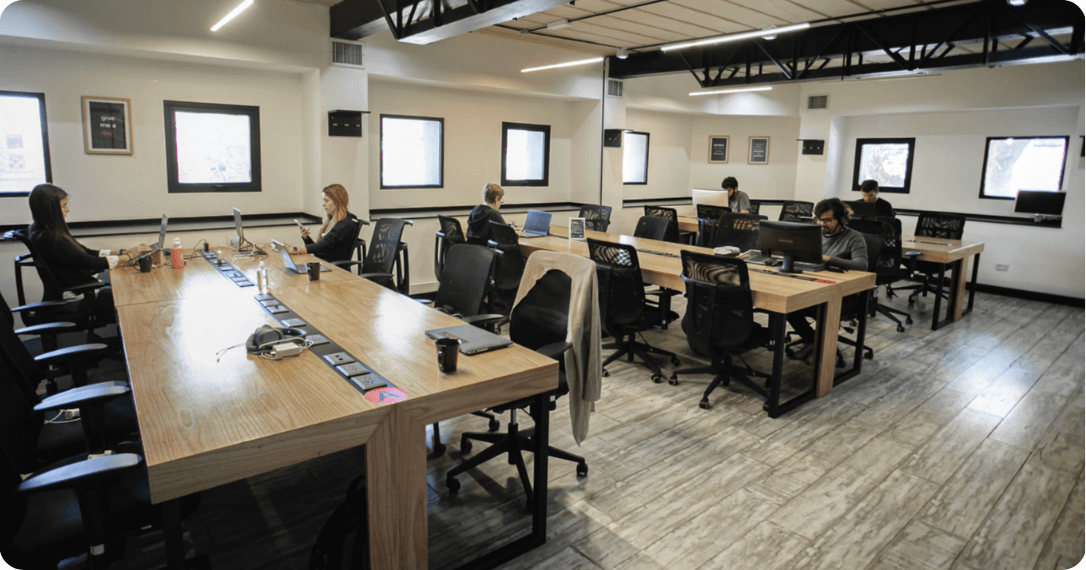
Shared Coworking Desk
The most widely available format. This is a space with hot desks available by the day or month, that grants access to stable WiFi, common areas, kitchen and meeting rooms. No assigned desk: anyone arrives, picks an available seat and starts working.
It is the most flexible format in terms of commitment and the most accessible in price. It works well for:
- Teams that need space two or three days a week without daily presence
- Companies that have just opened operations in a new city and need infrastructure from day one
- Remote professionals who want a more structured environment than home
Coworking spaces in Mexico City and in other cities across the Pluria network vary significantly in profile: some are oriented toward startups, others toward corporate teams, creative agencies or independent professionals.
Private Office Inside a Coworking
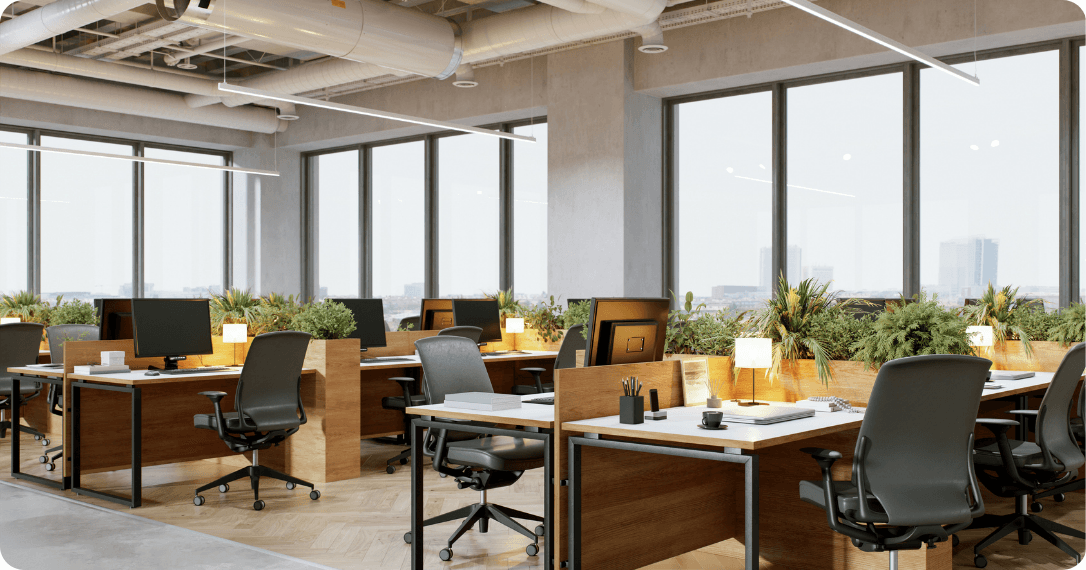
These are an exclusive space for the team, with a door, controlled access and full privacy, inside a managed building with shared services. No long-term lease, no fit-out costs, no exit penalty and no responsibility for space management.
The private office inside a coworking space gives the team a space of their own, with their own door and access code, while the building infrastructure, cleaning, internet, reception and common areas are shared and managed by the operator. The company does not pay for fit-out or hire a facilities manager, it moves in on day one with everything already working.
What a private office inside a coworking typically includes:
- Exclusive space for the team with controlled access
- Furniture included: desks, chairs, storage, meeting table
- High-speed internet
- Access to shared amenities: kitchen, common areas, printing, reception
- Flexible contract terms
- Option to scale up to a larger space as the team grows
It works well for teams of five to thirty people that need a fixed presence in a city without committing to a traditional lease. It is also the right choice for companies that have tried shared coworking and found that the team needs more privacy, more consistency or a dedicated space that feels like their own.
It is also increasingly common among international companies entering a new market: rather than signing a local lease and setting up a new office from scratch, they take a private office inside a coworking space, activate it in days and scale it as the local team grows.
Meeting Room by the Hour
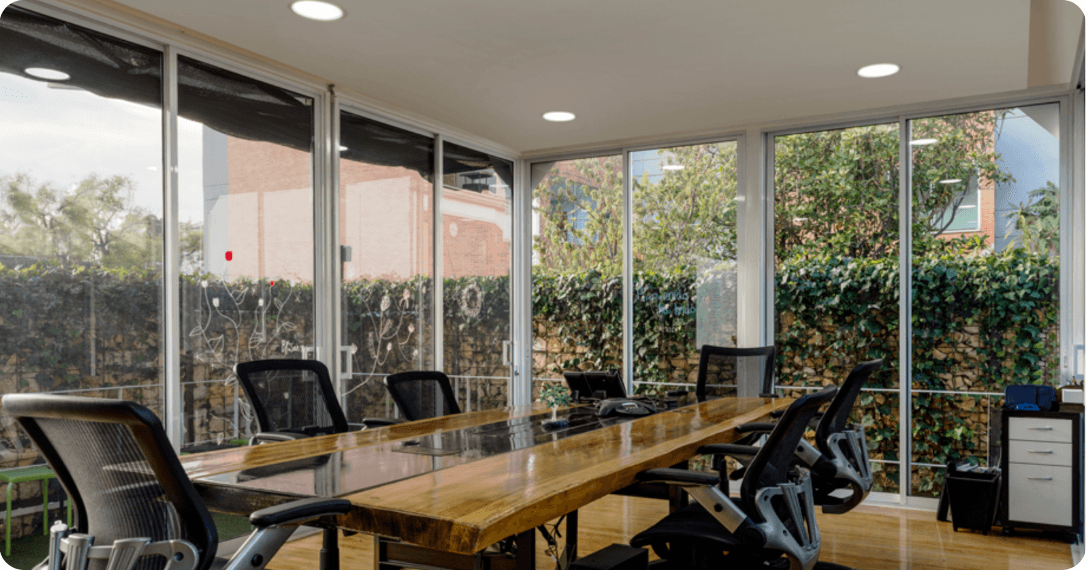
These are equipped rooms with projector, screen, video conferencing capability and capacity for four to twenty people, bookable from an app by the hour without a prior monthly membership.
It is one of the most requested resources among hybrid teams and one of the hardest to justify in an underused fixed office.
The case for hourly meeting rooms is straightforward: most teams do not need a meeting room every day. They need one on specific days, for specific purposes, often with little advance notice.
The hourly model prevents you from having to pay for what you don’t use. You book what you need, when you need it, and pay only for the time used. For teams that work hybrid and have irregular meeting schedules, this is structurally more efficient than any fixed room allocation.
What a well-equipped hourly meeting room includes:
- High-speed dedicated internet
- Video conferencing hardware: screen, camera, microphone and speaker
- Projector or large display for presentations
- Whiteboard or digital collaboration tools
- On-site support in case of technical issues
Coworking spaces in Bogotá and across the Pluria network offer meeting rooms bookable by the hour through the app, available the same day without a monthly commitment.
The same applies to coworking spaces in Buenos Aires and other cities: the room is booked, used and paid for, with nothing carried over to the following month.
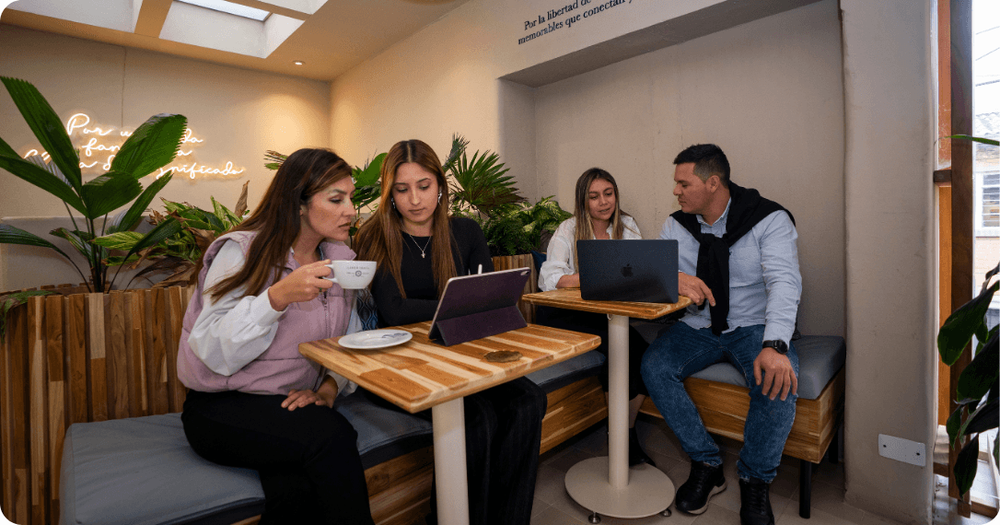
Work café
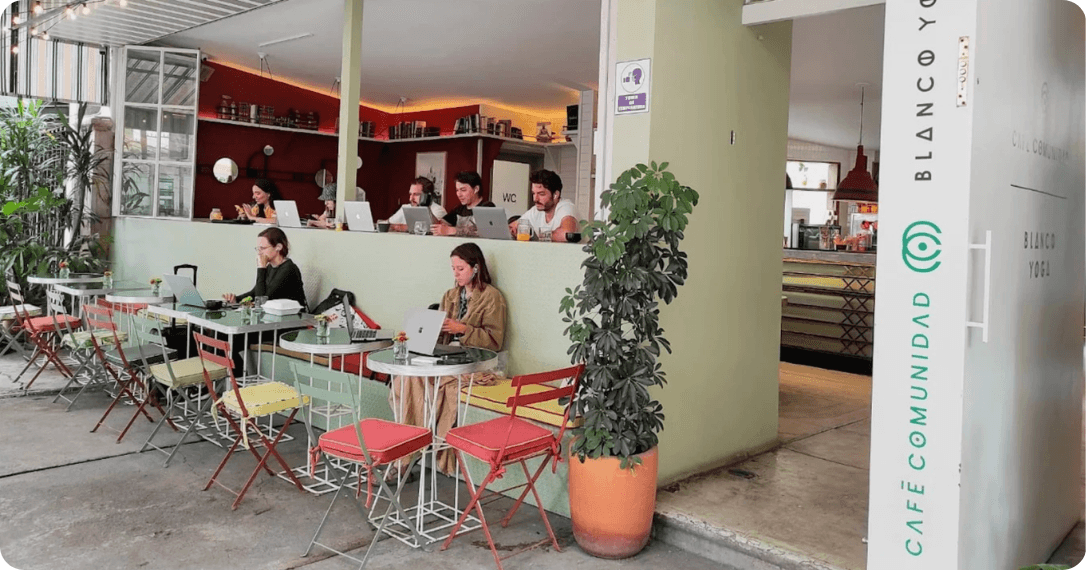
A café with stable WiFi, power outlets at every table and an environment designed for professional use alongside its primary function as a food and beverage space. This is not coworking, since there are no private meeting rooms and no presentation infrastructure.
What a work café offers:
- Low access cost, typically just the price of a coffee or a meal
- A stimulating atmosphere that works well for creative and individual focused work
- A genuine change of environment that many professionals find increases focus and energy
Work cafés work well for individual focused work without formal meetings, for hours of concentration between external commitments and for professionals who need a change of environment without committing to a full coworking day.
For teams that occasionally need a well-connected café with a professional atmosphere instead of a full coworking day, work cafés in Mexico City and other cities in the Pluria network are available from the same app alongside coworking spaces and meeting rooms, from the same account and on the same invoice.

How Flexible Work Solutions Grew in LATAM and Europe
Flexible work solutions expanded significantly in both regions after 2020, but for different reasons and at different speeds.
In Latin America, three structural factors drove growth:
- Traditional lease costs. In cities like Bogotá or Mexico City, a class-A office in a prime zone can cost between $180 and $600 USD per m² per year, according to CBRE Market Outlook 2024. For teams with variable presence, that cost does not scale with actual use.
- Hybrid model adoption. Remote work expanded significantly across LATAM after 2020, generating demand for professional infrastructure on an occasional basis rather than full-time occupancy.
- International company expansion. Companies from Europe, Asia and North America hiring talent in LATAM need to give their local teams workspace access without opening a full office from day one.
In Europe, the drivers are similar but the market is more mature. Cities like Bucharest have become significant hubs for distributed teams, with coworking spaces in Bucharest offering professional infrastructure at significantly lower cost than Western European capitals. Hot desk memberships in Bucharest start from around €100–140 per month, according to Allwork.Space's Romania Coworking Market Report 2025, roughly half the equivalent cost in Warsaw, Prague or Budapest.

The Problem that Flexible Workspace Alone does not Solve
What changed in recent years is not the availability of spaces but the fragmentation in managing them.
A company with teams in multiple LATAM cities can end up with coworking memberships in Bogotá, work café reimbursements in Buenos Aires, a private office in Mexico City, and a directly contracted meeting room in São Paulo. Four providers, four contracts, four invoices, zero consolidated visibility.
Pluria was built to solve that problem. Coworking, work cafés, meeting rooms, events and private offices, all managed from a single platform. The Pluria network operates across 20 countries including Colombia, Mexico, Argentina, Brazil, Chile, Peru and Romania.

How Companies Choose Their Workspace Model
There is no universally correct answer. Companies choose their workspace options for distributed teams based on four variables that change as the company evolves.
Team Size and Frequency of Use
For small teams with low presence requirements, access to a network of flexible coworking options for teams on a pay-per-use basis is almost always more efficient than a fixed office.
For large teams with daily in-person presence in a single city, a fixed office can be more competitive on cost per person. Most growing companies sit somewhere in between: mid-sized teams, variable presence, need to be in more than one city.
Number of Cities
A company with presence in more than one city faces a structural decision: replicate the fixed office model in each location, which multiplies administrative complexity, or access flexible infrastructure that works across all cities from a single platform.
Flexible offices for remote teams across multiple cities require a management model that scales without adding operational overhead per location.

Type of Meetings and Space Use
A team that meets with clients needs private rooms with presentation infrastructure. A team working in individual mode needs desks with reliable connectivity. A team running offsites needs event spaces.
Few companies have only one type of need, which makes a single provider for all types more efficient than managing separate providers by space category.
Cost Visibility and Control
For an ops manager or facilities lead, the workspace model decision does not end at finding the space. It ends at being able to answer: how much did the team spend on workspace this month? From which cities? How often did people share the same space?
Without those answers, the workspace budget is opaque and difficult to optimize. The best flexible workspace options for distributed teams are the ones that provide this visibility alongside the physical access.
For distributed teams looking to consolidate workspace access under a single provider, Pluria covers coworking, work cafés, meeting rooms, events and private offices across more than 20 countries. To see how it works for your team size and cities, request a Pluria demo directly.
Frequently Asked Questions
Remote work
Keep up to date with our most recent articles, events and all that Pluria has to offer you.
By subscribing to the newsletter you agree with the privacy policy.

The future is hard to predict.
Unfortunately, there’s no crystal ball that can tell us exactly what will happen. Yet, there are structured methods that[...]
22 October, 2025

In today’s fast-paced business environment, projects move faster than ever before.
Customer expectations shift constantly, new competitors enter [...]
29 October, 2025

More often than not, the best ideas do not develop in a linear fashion.
As a matter of fact, they usually emerge from a single word, an unexpected conn[...]
07 November, 2025