

Coworking vs Office vs Work Café: Which Model Works for You?

21 September, 2026
Share this article
Table of Contents
Most companies end up paying for a workspace model that does not match how their team actually works.
They have a fixed office running at 40% capacity, rely entirely on remote systems that lack the infrastructure for formal meetings, or they purchase individual coworking memberships when what they need is a corporate setup with centralized billing and bookable rooms.
Ultimately, the coworking vs office debate misses the point.
The real question is which combination of models minimizes your total workspace cost while giving your team the infrastructure it needs. This article compares all three with real numbers, concrete examples from LATAM and Europe, and a framework for making the decision with data rather than intuition.
If you already know what your team needs, you can see how Pluria Flex works for your team and request a demo with one of our team members.

Coworkings, cafés and fixed offices
Before comparing costs, it helps to define what each model actually consists of, because all three are frequently misunderstood.
- Corporate coworking is a managed access model for teams: centralized billing, bookable meeting rooms and the ability to operate across multiple cities without separate contracts. The average coworking cost in a corporate setup is calculated per person per day of actual use, not per square meter, which is what makes it structurally different from a fixed office.
- The fixed office is a leased space with a long-term contract, fixed monthly costs and full control over the physical environment. It is not the wrong model. It is the right model for specific conditions that fewer companies meet than they think.
- The work café is a consumption space used as a workspace. The distinction matters when a company adopts it as a primary workspace solution without understanding its limits.
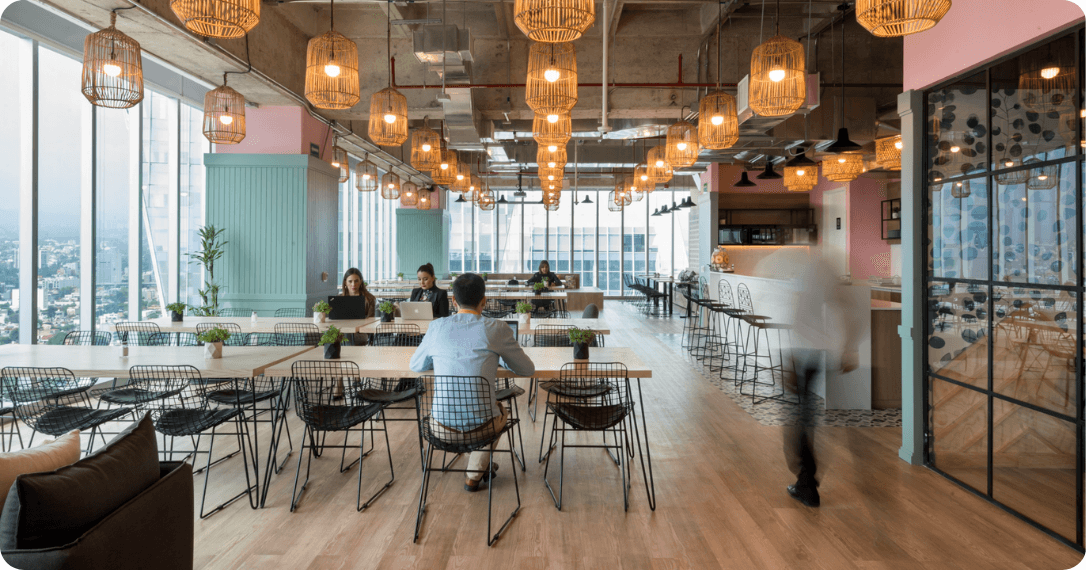
Corporate Coworking: More Than a Shared Desk
The difference between individual and corporate coworking is operational, not just a matter of scale.
With individual memberships, each person manages their own access, pays out of pocket and submits for reimbursement. With a corporate setup, the company has one account, one monthly invoice and a clear record of who used what space and when. That eliminates an administrative process that in teams of more than ten people consumes real time from finance and HR.
What a well-structured corporate coworking model includes:
- Desks available without mandatory advance booking
- Meeting rooms bookable by the hour without an additional monthly membership
- Access across multiple zones in the same city and across multiple cities
- One monthly invoice regardless of how many different spaces the team uses
- Admin panel with usage by person and location
Corporate coworking works well when the team operates in hybrid mode and does not need a fixed space every day, when the company operates in more than one city and needs infrastructure without separate local contracts, and when team growth is variable and committing to fixed square footage creates financial risk.
For distributed teams in LATAM, coworking spaces for teams in Bogotá and other cities in the network allow teams to activate professional presence in days, not weeks.
The coworking vs office calculation also changes when you factor in meeting room costs. In a fixed office, rooms sit empty most of the time but cost the same every month. In a corporate coworking model, you book a room when you need it and pay only then.
Another benefit of coworking spaces is the availability of bookable meeting rooms. With tools like Pluria, you can book meeting rooms in Buenos Aires and other cities in the network, from the same app and without separate invoices.

The Fixed Office: When It Works and When It Doesn't
The fixed office is not the enemy of flexible work. It is a model with clear use cases that works well when the conditions justify it and generates unnecessary costs when they do not.
What a fixed office includes and what it implies:
- Exclusive space with full control over the physical environment
- Long-term lease contract, typically 12 to 36 months
- Fixed monthly costs regardless of actual use: rent, utilities, maintenance, fit-out
- Direct responsibility for space management
- High exit cost if the team changes size or city
The fixed office works well when the team is large and stable, when daily in-person presence is part of the business model, or when the team scale makes the cost per person of a private office lower than flexible alternatives.
The most common problem with private office vs coworking space cost analysis in LATAM is not having a fixed office. It is having one space for a headcount that no longer matches actual usage.
Teams that moved to hybrid after 2020 and kept contracts signed for full-time occupancy saw spaces running at 40% to 50% capacity with 100% fixed costs. The cost of coworking vs fixed office gap widens significantly when you calculate cost per person per day of actual use rather than cost per month divided by headcount.
Private offices inside coworking spaces
There is a middle ground between these options that many companies overlook: private offices inside coworking spaces.
These consist of exclusive spaces for teams, with a door and privacy, but without a long-term lease or fit-out costs. For teams of five to thirty people that need a fixed presence in a city without committing to a traditional lease, it combines the best of both models.
You can explore available options through Pluria private offices across the network.

The Work Café: A Great Option for Informal Teamwork
The work café is a legitimate workspace option with a specific and limited scope. The problem is not using it. The problem is deploying it for situations that require infrastructure it cannot provide.
What a work café offers:
- Full flexibility with no booking required and no minimum commitment
- Low access cost, typically just the price of a coffee or lunch
- A stimulating atmosphere that works well for creative and individual focused work
- A genuine change of environment that many professionals find increases focus and energy
Where its limits are:
- No private rooms for client calls or team meetings
- No presentation infrastructure or dedicated workspace equipment
They make sense for individual work or informal meetings, for professionals who need a change of environment for a few hours and for people that need to grab a bite while finishing their work.
For teams that occasionally need a well-connected café with a professional atmosphere instead of a full coworking space, work cafés in Mexico City and other cities in the Pluria network are available from the same app without an additional membership.

How Much Does Coworking Cost Per Employee vs a Fixed Office?
The cost of coworking vs fixed office comparison looks different depending on which number you use. Most companies compare monthly rent against monthly coworking fees and conclude the office is cheaper. That calculation ignores utilization.
A fixed office in a prime zone in Mexico City costs between $350 and $600 USD per m² per year, according to CBRE Market Outlook 2024. A team of 20 people in 200 m² pays between $5,800 and $10,000 USD per month.
If that team works hybrid and occupies the office at 60% capacity, the real cost per person per day of actual use rises between 40% and 70% above what appears on the rent invoice.
The same team in a corporate coworking model using the space three days a week pays between $1,800 and $3,000 USD per month with no fixed costs, no fit-out and no exit penalty.
So, how much does coworking cost per employee in practice?
The answer mostly depends on the city, the model and the frequency of use. A useful benchmark across LATAM and Europe:
- Mexico City (Reforma/Polanco): fixed office $350–600 USD/m²/year vs coworking from $23 USD per person per day booked
- Bogotá (Chicó/Zona Rosa): fixed office $180–320 USD/m²/year vs coworking from $23 USD per person per day booked
- Buenos Aires (Palermo/Microcentro): fixed office $150–280 USD/m²/year, with inflation indexation adding unpredictability
The average coworking cost in a corporate model with Pluria is US$23 per person per day booked, with no monthly subscription.
For larger organizations, volume pricing starts from US$14. In both cases, the cost only applies when the team actually uses the space.
The private office vs coworking space cost gap narrows significantly when you include all fixed office costs: rent, utilities, cleaning, maintenance, internet, furniture and fit-out amortized over the contract period.
For teams under 30 people working hybrid, the all-in cost of a private office inside a coworking space is typically lower than a traditional lease once those line items are added.

Coworking vs Work Café vs Office: How to Decide for Your Team
There is no universally correct answer for this question, but there is a correct answer depending on your team size, the cities where you operate and your actual usage pattern.
Answering these four questions can help you identify the best solution for your team:
How many people need a workspace and how often?
If there are fewer than ten people going to a space two or three days a week, corporate coworking in Bucharest and other cities is almost always more efficient than a fixed office.
If there are more than thirty people with daily in-person presence in a single city, the fixed office starts to compete on cost per person. Between those two extremes, coworking vs office efficiency depends on actual utilization, not on the perception of how much the team uses the space.
How many cities does the team operate in?
A company with presence in more than one city that tries to replicate the fixed office model in each one multiplies complexity without scaling efficiency.
A flexible workspace model with centralized access is the only option that works at multi-city scale without a dedicated facilities team per city. The cost of coworking vs fixed office advantage compounds with each additional city.
What type of meetings does the team need most?
If meetings are primarily internal and collaborative, a bookable room in a corporate coworking space covers most cases. If meetings regularly involve external clients who expect a fixed address and reception, the calculation changes.
If meetings are infrequent and mostly individual, a work café covers most days. Understanding the actual meeting pattern before choosing a model saves significant cost. The how much does coworking cost per employee question has a very different answer depending on whether you need rooms every day or once a week.
What does the current model actually cost?
Before evaluating alternatives, calculate the cost per person per day of actual use in the current model, not the monthly cost divided by headcount. That metric almost always reveals the existing model is more expensive than it appears in the facilities budget. The private office vs coworking space cost comparison looks very different once utilization is factored in.

Pluria as Infrastructure for Any Model
Whatever combination your company chooses, Pluria provides access to all three models from a single platform: coworking spaces, work cafés, meeting rooms and private offices across more than 130 cities in LATAM, Europe and beyond. One account, one monthly invoice, no separate contracts by city or space type.
See how Pluria Flex works for your team and request a Pluria demo to explore specific options for your team size and cities.
FAQs
Remote work
Keep up to date with our most recent articles, events and all that Pluria has to offer you.
By subscribing to the newsletter you agree with the privacy policy.

The future is hard to predict.
Unfortunately, there’s no crystal ball that can tell us exactly what will happen. Yet, there are structured methods that[...]
22 October, 2025

In today’s fast-paced business environment, projects move faster than ever before.
Customer expectations shift constantly, new competitors enter [...]
29 October, 2025

More often than not, the best ideas do not develop in a linear fashion.
As a matter of fact, they usually emerge from a single word, an unexpected conn[...]
07 November, 2025