

What is a Go To Market Analysis?

20 December, 2025
Share this article
Table of Contents
A few months ago, a company told me they had rolled out a hybrid work policy, but none of the employees were actually following it.
Not because people disliked the idea, but because the rollout had no structure. Teams in Bogotá were working one way, people in São Paulo another, and employees in Madrid were not even sure the policy applied to them.
HR had spent weeks preparing documents, but without a clear audience, message, or adoption plan, the launch fell apart the moment it reached real workers.
It was not a lack of talent or effort. It was a lack of alignment.
When teams are spread across different cities and countries, even a small change can feel confusing if it does not come with context or preparation. Guesswork becomes the default, and let’s face it, this should never be the way to start a project.
What they needed was not another meeting. They needed a go to market analysis for their internal change. In other words, they needed a structured way to understand who their audience was, what each group valued, and how to introduce the policy in a way that actually fit their day to day experience.
Product teams do this every time they launch something new. HR and project leaders deserve the same clarity.
A GTM analysis gives you that clarity. It helps you map your audience, define your value, choose the right distribution channels, and design the experience you want people to have at every stage.
Whether you are releasing a product or rolling out a workplace policy, the logic is the same. Once you see it that way, the entire process becomes easier to navigate.
If you have ever launched something that did not land the way you hoped, you are not alone.
Throughout this article, you will learn how a go to market analysis works, why it matters, and how to build one that actually supports your team instead of overwhelming it.
What is a Go To Market Analysis?
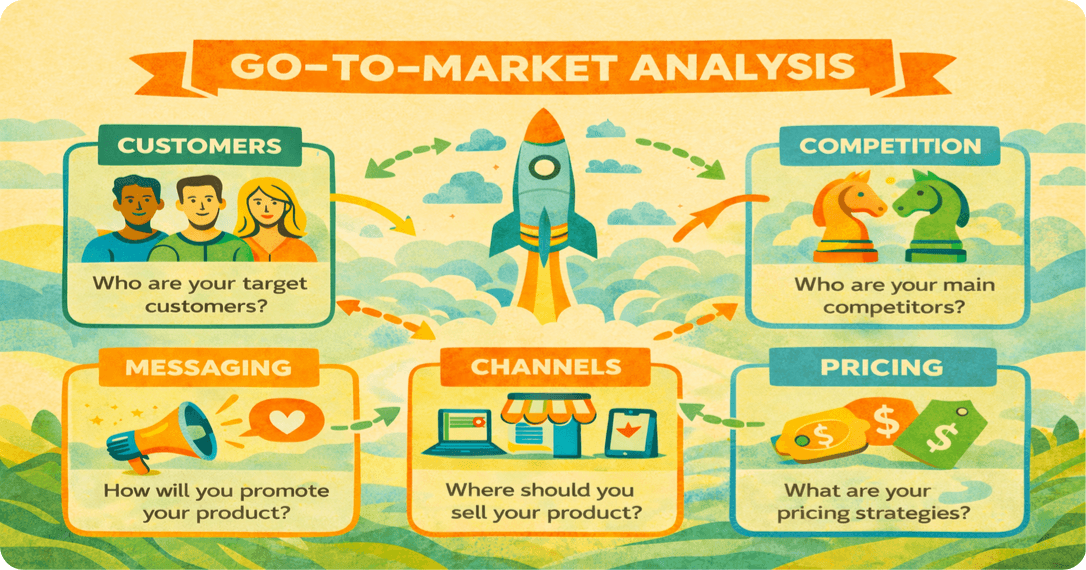
A go to market analysis is a structured way to understand how a product, service, or initiative should reach the people it is meant for.
It helps you define who your audience is, what problem you are solving for them, what makes your solution valuable, and how you will deliver it in a way that they can adopt easily.
In simple terms, it is the strategy behind how an idea becomes real in the world.
Brief History of the GTM Plan
The idea of a market GTM strategy started inside sales and marketing teams.
It was once a technical exercise used mainly for product launches with clear distribution channels, pricing models, and sales motions.
As markets became more competitive and audiences more fragmented, teams realized that intuition alone was not enough to guide major decisions.
Over time, the GTM framework expanded. Product teams adopted it to validate new features. Operations teams used it to introduce internal processes. HR teams saw its value when rolling out company wide programs.
What started as a commercial tool slowly became a universal planning method to navigate complexity with less marketing efforts.
GTM Today
Today, a go to market analysis is no longer limited to selling something. It is a thinking process that helps teams understand who they are trying to reach, what those people need, and how to deliver a solution in a way that feels clear and relevant.
To see how flexible this approach is, imagine a simple everyday scenario.
You plan a small neighborhood party. You pick a date, choose a location, and invite people over. But only three of them show up.
After throwing a small tantrum you realize that the problem was never the event itself. It is that you never defined who it was for or why they should care. A small GTM analysis would have changed the outcome and you might have had more people show up to the party.
Now think of an HR scenario. A company launches a new feedback framework meant to improve performance conversations. The idea is strong, but adoption is low. Managers use it inconsistently and employees do not see its value. Remote teams feel even more disconnected.
The issue is not the framework. It is the lack of a GTM approach. HR needed to identify which teams had the biggest pain points, how each group preferred to learn, and what message would make the change meaningful. With a proper GTM analysis, the rollout would have landed with clarity instead of confusion.
A modern GTM analysis helps any team, in any industry, introduce ideas that people can actually understand and adopt.

How to Build a GTM Plan
Creating a GTM plan is less about writing a perfect document and more about building clarity before taking action.
It forces you to slow down, understand your audience, and shape a path that makes adoption smoother for everyone. The steps are simple, but the value comes from doing them with honesty and discipline.
1. Define the Problem You Are Solving
Before thinking about channels or messages, you need a clear understanding of the problem your solution addresses. If the problem is vague, the GTM plan will be vague too.
Example: A software company notices that small retailers struggle to track inventory efficiently. The GTM plan begins by naming the real problem: manual stock tracking causes errors, delays, and lost revenue. This clarity shapes every later decision.
2. Identify Your Target Audience
A GTM plan only works when you know exactly who you are trying to reach. Not everyone needs your solution, and trying to speak to everyone weakens your message.
Example: A fitness startup is launching a wellness app. Instead of targeting “all adults who want to be healthier,” they narrow it down to busy professionals in their thirties who need quick routines and stress management.
3. Understand Your Competitive Landscape
Map out competitors, alternatives, and behaviors your audience already uses. This helps you understand what makes your solution different or better and creates direction for your marketing efforts.
Example: A local bakery wants to sell custom celebration cakes online. When they analyze competitors, they discover that most shops have long order times. Their advantage is speed. They decide to highlight same week delivery as their key differentiator.
4. Define Your Value Proposition
This is the core message that explains why someone should choose your solution. It must be simple, concrete, and tied directly to the problem you defined earlier.
Example: A tutoring service realizes parents care most about confidence building, not test scores alone. Their value proposition becomes: “We help students feel capable, so their grades improve naturally.” This resonates more than generic academic promises.
5. Choose Your Distribution Channels
Identify the best places to reach your audience. Channels should match how your audience already behaves, not how you wish they behaved.
Example: A skincare brand wants to reach young adults. Instead of relying on email newsletters, they invest in TikTok creators and short product demo videos because that is where their audience spends time.
6. Shape the Customer Experience
Think through the entire journey: what people see first, how they interact with your solution, and what happens after they take action. A GTM plan works when the experience feels easy and intuitive.
Example: A meal subscription service removes all friction by letting users choose meals with one tap, skip weeks easily, and cancel without calling support. The smoother experience becomes a competitive advantage.
7. Set Metrics and Feedback Loops
A GTM plan needs measurable goals so you can track what is working and what needs adjustment. Feedback loops keep you from guessing.
Example: A consulting firm carries out a leadership workshop to track sign ups, completion rates, and post training confidence scores. When one module scores low, they revise it instead of relying on assumptions.
8. Start Small and Iterate
A GTM plan is not meant to be executed all at once. Starting with a smaller group or market helps you validate assumptions before scaling.
Example: A new coworking space opens in a large city. Instead of targeting the entire business community, they test the concept with freelancers in a single neighborhood. The first group’s feedback shapes the next phase of expansion.
Benefits of Creating a Go To Market Analysis
Launching something new and innovative is always tempting. You want to move fast, impress stakeholders, and create more competitive advantages.
But moving fast without a clear market GTM strategy usually leads to confusion, meaning a lot of questions that surface at the worst moment.
A GTM analysis protects your team from that chaos by giving you clarity before you invest time, resources, or energy.
Here are 5 benefits of implementing a go to market strategy before moving forward with a new project:
- Better Alignment Across Teams: Instead of each team interpreting the goal differently, the GTM gives one shared understanding of the problem, the audience, and the path forward. This reduces friction in meetings and helps teams collaborate with less confusion. When alignment is strong, execution becomes smoother and decision making becomes faster.
- Lower Risk and Fewer Costly Surprises: A proper analysis forces you to validate initial assumptions you might have early, which reduces the chance of launching something people do not need or will not adopt. It also uncovers blind spots before they turn into expensive problems.
- Sharper Prioritization of Effort and Budget: A GTM analysis helps you identify where your resources matter most. When you know your audience and channels, you stop spreading your efforts thin and start doubling down where impact is highest. This leads to more efficient spending and clearer priorities.
- Stronger Understanding of Your Customer Experience: A GTM analysis makes you walk through the customer journey step by step. It helps you catch points of friction that would frustrate users or employees later. When the journey feels clean and intuitive, adoption increases naturally.
- Higher Adoption and Engagement After Launch: A strong GTM plan prepares your audience for what is coming. People understand the value, the timing, and how the change fits into their world. This leads to better engagement, fewer support tickets, and a more stable launch.
A GTM analysis does not remove all uncertainty, but it gives your team a practical map to follow when things get messy.
It turns scattered assumptions into shared direction and replaces guesswork with informed choices. When you treat your launch with this level of intention, the work feels lighter and the outcome becomes easier to trust.

How to Find Your Target Audience For a GTM Plan
I once worked with a team that built a beautiful onboarding program for new employees. It had videos, guides, and even a small quiz at the end.
The problem was that it was designed for people who worked full time in the office. Half of the new hires were remote, many were in different time zones, and the examples in the training did not reflect their reality at all.
The program was well built, but it was built for the wrong audience. Engagement dropped fast, and the team had to rebuild everything from scratch.
A similar thing happens in product launches.
A startup once told me they had created an app to help people manage weekly meals. They assumed their audience was everyone who wanted to eat healthier. After a few months of low adoption, they realized their actual users were busy parents who needed fast decisions, not food enthusiasts looking for inspiration.
Once they refocused on that group, everything clicked. The messaging became simpler, the app became more practical, and the growth finally picked up.
Your target audience is not who you hope will love your solution. It is the group whose daily life changes when they use it. When you understand them well, you build something people can see themselves in.
Here are four steps to find that group with more clarity.
Step 1: Identify who feels the pain the most
Start by asking a simple question: who suffers the problem you are solving in a direct and consistent way? Focus on people who experience the pain in their daily routine, not those who find it mildly inconvenient.
Example: In a company with low meeting engagement, the real audience is not the entire workforce. It is team leads who struggle to run conversations that feel productive.
Step 2: Understand their current behavior
Look at what your audience is already doing to solve the problem. Their habits reveal what they value and what they avoid, opening the door for your company to develop new competitive advantages.
Example: If remote employees track work updates inside informal chat groups, it shows they prefer quick communication over long formal reports.
Step 3: Map what motivates them
Every audience has a mix of emotional and practical motivators. Clarifying those will help you shape your message in a way that resonates instead of sounding generic.
Example: Managers may adopt a new tool faster if it saves time, but frontline employees may care more about reducing confusion in their workflow.
Step 4: Narrow it down, then validate
Your audience should be focused enough to design a clear message but broad enough to have meaningful impact. Once you define the group, test your assumptions with interviews or early pilots.
Example: A wellness program tested first with employees who report high stress gives HR better feedback than launching it to the entire company at once.

Tips to Create an Effective GTM Strategy
The best GTM strategies rarely come from long documents. They come from teams that stay curious, listen closely, and adjust faster than expected.
A good GTM plan is not about being perfect on paper. It is about choosing the next smart move and making sure it truly fits the people you want to reach.
Here are seven practical tips that keep your strategy grounded in reality:
- Start with honest research: Talk to real users before you make assumptions about what they want. Even three short conversations can correct weeks of guesswork.
- Keep your message simple: If people cannot repeat your value in one sentence, they will not remember it. Clarity always beats clever wording.
- Use small pilots to validate ideas: Test your concept with a small group before scaling the launch. Early feedback gives you direction instead of surprises.
- Choose channels your audience already trusts: Meet people where they are, not where you wish they were. Your GTM gets stronger when your channels fit real behavior.
- Focus on one core promise: Pick the single result your audience cares about most and build around it. A narrow promise is easier to deliver consistently.
- Make adoption feel effortless: Remove friction from the first interaction to the last. The smoother the experience, the higher the adoption.
- Review and adjust continuously: A GTM plan is not a fixed roadmap. Treat it as a living process that evolves with every new insight.
A go to market analysis is not a corporate formality. It is a way to bring intention to your work before you bring it to the world.
When you understand your audience, define your value clearly, and choose the right channels, you give your idea a real chance to succeed instead of hoping it survives by luck.
Most teams do not fail because their ideas are weak. They struggle because their launch arrives without context, clarity, or a plan that reflects the people it is meant to serve as well as the company's competitive advantages.
A good GTM strategy protects you from that. It turns confusion into direction and reduces the pressure that usually comes with introducing something new.
If you have ever launched a product, a policy, or a process that did not land the way you expected, now you know there is a better way forward. A thoughtful GTM approach helps you move with confidence and design an experience your audience can actually adopt.
If you want to build this skill, start small. Pick one idea you have been meaning to launch and write down who it is for, why it matters, and how you plan to introduce it. You don't need huge marketing efforts, even ten quiet minutes of clarity can change the entire direction of your next project. Your first GTM analysis does not need to be perfect. It only needs to be honest.
When you are ready to bring more alignment to your team or support people working across different cities, tools like Pluria can help you turn that strategy into day to day practice. Good ideas become easier to adopt when the environment supports them.
Remote work
Keep up to date with our most recent articles, events and all that Pluria has to offer you.
By subscribing to the newsletter you agree with the privacy policy.

The future is hard to predict.
Unfortunately, there’s no crystal ball that can tell us exactly what will happen. Yet, there are structured methods that[...]
22 October, 2025

In today’s fast-paced business environment, projects move faster than ever before.
Customer expectations shift constantly, new competitors enter [...]
29 October, 2025

More often than not, the best ideas do not develop in a linear fashion.
As a matter of fact, they usually emerge from a single word, an unexpected conn[...]
07 November, 2025