The Top Down Approach

16 December, 2025
Share this article
Table of Contents
Imagine you are a film producer and a major Hollywood studio hires you to develop their next blockbuster film.
Suddenly you are responsible for coordinating a large team of writers, technicians and creative specialists who must work together to bring an ambitious project to life.
But with that excitement comes uncertainty. After all, you are also the one expected to define the final budget, set the production timeline, and make the most important decisions in regards to the project.
Hence, a crucial question quickly emerges: Should you define the goals yourself and hire teams to execute them, or should you surround yourself with experts who set their own standards and contribute to the project more collaboratively?
At first glance, this question may sound like a comparison between autocratic and democratic leadership. But the issue is more intricate. It deals fundamentally with how we structure a project, how we design a clear direction, and how that direction flows through an organization.
It is not only about leading others. It is about choosing the approach to management that shapes how you plan, communicate and make decisions at every level.
In this guide, we will explore what is Top Down approach, a framework where strategic direction starts at the top and flows down through departments and teams. You will discover what this approach really means, when it works best, and how it applies to areas such as business management, software development, and project planning.
If you are managing your own “blockbuster” at work and want a clear understanding of the meaning of Top Down, its advantages, and challenges of implementing it, this guide will help you navigate it with confidence.
The Top Down Approach
What is Top Down Approach?
The Top Down approach is a method of analysis, planning and problem solving that starts with the big picture. Leaders define the vision, strategic direction and major goals first. Only then are these goals broken down into smaller components and individual tasks.
In simple terms, you decide what needs to be achieved before defining how it will be executed. This way you can execute robust plans while increasing employee engagement.
The strength of the top down management style is that everyone begins with the same clear photograph of the project. Much like looking at a map before choosing the precise route, it reduces confusion, misalignment and duplicated work.
Brief History of the Top Down Approach
Although the Top Down approach is widely used today in business and project management, its roots lie in twentieth century engineering and computer science.
During the 1950s and 60s, engineers and computer scientists faced increasingly complex systems. It turns out that designing isolated components without understanding the whole system created costly errors. To solve this, researchers formalized a new method: analyze the whole first, then design each part based on that structure.
In programming, the idea became central to structured development. Figures like Niklaus Wirth, creator of Pascal, promoted designing software by starting with the main function and breaking it into smaller modules. This principle shaped early algorithm design and later influenced modern architecture in computing.
Over time, the Top Down approach migrated into other disciplines. Strategy consultants, organizational theorists and business leaders adopted it to guide large-scale decisions and align teams around long-term goals.
The method proved especially useful for organizations that needed clarity, consistency and coherent communication from leadership to teams.
The Top Down Management Style Today
Today, the Top Down approach is widely used in sectors where clarity saves time, resources and uncertainty:
- In business management, leaders use it to define strategic direction and cascade goals to departments.
- In software development, teams map system architecture before writing a single line of code.
- In project management, a project manager uses the Top Down approach to define scope, budgets, milestones and expand employee engagement.
Modern organizations often combine Top Down with more democratic practices. A leader defines the vision, while teams contribute insights and improvements from their own expertise. This balance strengthens alignment without sacrificing creativity or employee engagement.
In increasingly complex environments, the Top Down approach offers something both simple and powerful: a clear starting point for coordinated action.

How Does the Top Down Decision-Making Process Work?
The Top Down approach starts with the big idea and breaks it into smaller, actionable parts. Here is how the process works step-by-step, following the film producer example introduced earlier:
1. Define the overall vision
This is the highest-level statement of purpose. The big-picture objective that will serve as the anchor for the whole project, hence, it needs to be specific, attainable, and measurable.
Example: A producer defines the vision for a new film: “Create a story that emotionally connects with young adults.”
2. Set strategic objectives
These objectives break the vision into major goals. It is the first example of breaking down the general vision into particular elements.
Example: In order to complete the main goal, the film producer will have to:
- Deliver a final script within six months.
- Secure international distribution partners.
- Build a financial plan that protects the project’s budget.
3. Break objectives into smaller components
Each large goal is split into subprojects and responsibilities. These often represent different areas or components of a project, to be achieved by experts in said fields.
Example: In order to finalize the script, the producer must first:
- Carry out audience research
- Hire writers
- Deliver a first draft
- Allow time for the editorial review
- Approve a final version
4. Assign responsibilities
Each component is assigned to an appropriate team or expert for execution.
The film producer would assign writers with the task of screenwriting, a sales team with finding international distributors, and a financial advisor to help him with the creation of the financial plan.
5. Establish review and control mechanisms
Top Down planning requires structured monitoring to ensure alignment with the original vision.
The producing and writing team behind the blockbuster movie plans to meet once a week in order to exchange ideas and status updates. They also monitor results and KPIs.

Top Down in Different Sectors
The Top Down approach can sound abstract when you first hear about it, but in practice it shapes far more of our professional lives than most people realize.
Here’s how the top down approach plays out in three fields where it has a real and measurable impact:
Top Down in Business and Management
The Top Down approach to management is common in organizations that require strong strategic alignment. Leaders define the direction, and departments translate it into practical plans.
It can become useful in the following circumstances:
- a company enters a new market
- launches a major product
- restructures processes
- implements company-wide cultural changes
Top Down in IT and Programming
In computer science, the Top Down approach is foundational in system design and algorithm development. Developers outline the complete structure and break it into modules, ensuring that every part aligns with the main function.
If developers start coding individual modules without understanding the global architecture, the final product becomes a patchwork of mismatched ideas.
Top down avoids that, reduces complexity, prevents errors and increases efficiency.
Top Down in Project Management
A project manager often starts with a Top Down structure: define the project scope, main deliverables, timelines and responsible teams. From there, tasks are divided into phases and sub-tasks.
This helps anticipate risks early and ensures consistent progress across different areas.
Large-scale projects like system migrations, brand redesigns or global rollouts rely heavily on Top Down thinking to avoid fragmentation and confusion.
Top Down vs Bottom Up
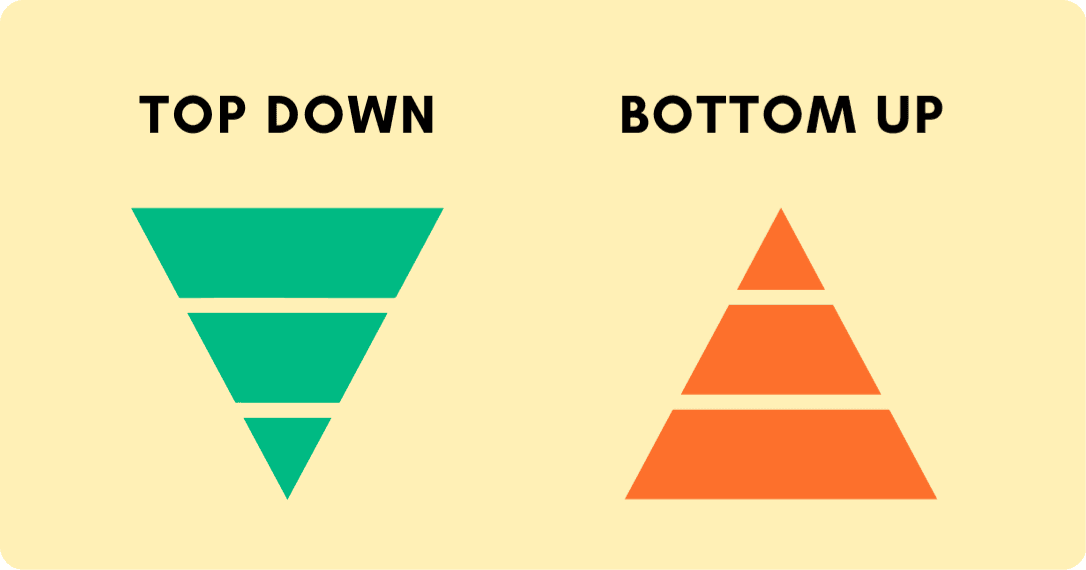
To fully understand the top down approach, you have to see it alongside its natural counterpart: the Bottom Up approach.
If Top Down starts with leadership, Bottom Up management starts with the people who are closest to the problem. This approach assumes that the best improvements often come from those who experience issues every day:
- frontline teams
- technical specialists
- customer-facing employees
- engineers
- support teams
These people notice inefficiencies that leadership may overlook, and they propose ideas rooted in reality, not assumptions.Therefore Bottom Up often leads to better employee engagement, because teams feel part of the solution rather than passive executors of someone else’s plan.
The Top Down and Bottom Up approach differ in:
Starting Point:
- Top Down: decisions start with leadership.
- Bottom Up: ideas originate from the teams performing daily work.
Autonomy:
- Top Down: clearer direction, less room for team-driven decision making.
- Bottom Up: empowers teams to design solutions based on practical experience.
Speed:
- Top Down is faster for large strategic decisions.
- Bottom Up is slower but builds deeper commitment.
Advantages and Disadvantages of the Top Down Approach
Before deciding whether to use a Top Down approach, it’s important to examine both its strengths and its blind spots.
This is not a style of leadership that works in every scenario. It is a tool, and like any tool, its impact depends entirely on how and when it is used.
Advantages of the Top Down Approach
- Immediate strategic clarity: When objectives come from the top, there is no debate about direction. Teams move faster because they are not guessing priorities or negotiating focus.
- Strong coordination in complex environments: When many teams need to collaborate, top down ensures that everyone is building toward the same architecture, not reinventing it.
- Better resource allocation: Leadership can see which projects genuinely move the business forward. Top Down allows budgets, people and tools to be assigned with strategy in mind, not politics.
- Faster implementation during urgent moments: A company under pressure cannot spend weeks debating. Top Down accelerates the decision making process when speed is essential.
- Scalability: A clear top down structure can be replicated across countries, divisions or product lines.It becomes a blueprint for organizational consistency.
Disadvantages of the Top Down Approach
- Lower employee participation: If used rigidly, top down can make teams feel like order-takers. This reduces motivation and weakens employee engagement.
- Risk of unrealistic decisions: When plans are crafted too far from the operational reality, the organization may discover problems too late.
- Reduced flexibility: Top down structures can be slow to adapt. If the environment changes quickly, teams may struggle to adjust the original plan.
- Internal resistance: If decisions come down as mandates instead of shared goals, teams can resist emotionally or disengage silently.
- High dependence on leadership quality: If the leadership misreads the situation, the entire organization suffers because the plan originates from a single point of view.

Every time I’ve been responsible for a large project, I’ve realized that clarity at the top unlocks confidence across the entire organization. A good decision making process is not only about efficiency; it is about giving people a direction they can trust.
The Top Down approach is not perfect, but when used wisely, it removes uncertainty, aligns teams and turns an abstract idea into a structure people can actually execute.
Before you close this guide, I invite you to try something simple: Choose one important decision you’ve been postponing and define it Top Down. Write the vision, outline the objectives and communicate them clearly to your team.
Then observe what changes.
Sometimes one clear move from the top is enough to help an entire project fall back into place.
Remote work
Keep up to date with our most recent articles, events and all that Pluria has to offer you.
By subscribing to the newsletter you agree with the privacy policy.

The future is hard to predict.
Unfortunately, there’s no crystal ball that can tell us exactly what will happen. Yet, there are structured methods that[...]
22 October, 2025

In today’s fast-paced business environment, projects move faster than ever before.
Customer expectations shift constantly, new competitors enter [...]
29 October, 2025
More often than not, the best ideas do not develop in a linear fashion.
As a matter of fact, they usually emerge from a single word, an unexpected conn[...]
07 November, 2025