

The Importance of Employee Wellbeing at Work

04 February, 2026
Share this article
Table of Contents
For a long time, I thought that being tired was just a normal part of work.
Not exhausted. Not burned out. Just tired. That kind of tiredness that doesn’t go away by sleeping more hours or taking short vacations. The kind that stays in your head, even long after the day is over.
What’s curious is that if someone asked me how I was doing, the answer came out automatically: “fine.”
After all, work was moving forward, tasks were getting done, and from the outside there was no obvious reason to worry.
But inside, something always felt tight. Like a constant pressure that never really let go, even after closing the laptop.
Over time, I realized that this had a name. And it wasn’t a lack of discipline or motivation. It had to do with employee wellbeing. Or more accurately, with its quiet absence.
I have seen this repeat itself in many people. Leaders, HR teams, brilliant professionals who genuinely care about what they do but slowly begin to operate on autopilot. Not because work doesn’t matter to them, but because sustaining that emotional rhythm comes at a cost.
The problem is that for years we learned to normalize it.
We normalized constant stress, permanent urgency, and the feeling that we could always be doing “a bit more.” In that process, we stopped asking ourselves how working this way was actually affecting us.
That’s where employee wellbeing in the workplace stops being a nice phrase for presentations and becomes something deeply personal. Because this is not just about productivity or results. It’s about what it feels like to live your work every single day.
From a psychological perspective, we know that work directly impacts our mental health, our identity, and our sense of control over our lives.
Psychological wellbeing at work does not appear simply because a company declares it as values. It appears when there is consistency between what is said and what is actually lived.
In this article, I want to explore this topic without empty speeches. From a human, everyday, imperfect perspective.
We will look at what employee wellbeing really means today, how it has evolved, why it is essential for emotional and psychological health, and what leaders and HR teams can do to build healthier and more sustainable environments.
Because if work occupies such a large part of our lives, it should at least be a place where we don’t have to sacrifice our mental balance just to function.
Employee Wellbeing in the Workplace
What Is Employee Wellbeing?
Employee wellbeing refers to the overall quality of a person’s experience at work, not just in terms of performance, but in how work affects their mental, emotional, physical, and social health over time.
At its core, employee wellbeing is about whether work supports a person’s ability to function, grow, and sustain themselves without constant depletion. It goes beyond benefits, wellness programs, or isolated initiatives. It reflects how daily work actually feels.
An efficient employee wellbeing strategy includes several interconnected dimensions:
- Emotional wellbeing, which relates to how safe, supported, and valued people feel at work. This includes stress levels, emotional load, and the ability to express concerns without fear.
- Psychological wellbeing, which involves autonomy, clarity, sense of control, and the ability to think, learn, and make decisions without being in constant survival mode.
- Physical wellbeing, which is affected by workload, rest, ergonomics, and the pace at which work is expected to happen.
- Social wellbeing, which relates to belonging, trust, and the quality of relationships within teams and organizations.
A brief historical context
For a long time, work was not designed with emotional wellbeing in mind.
Historically, the focus was almost always on productivity, efficiency, and control. What people felt while working was, at best, irrelevant.
In early organizational psychology, especially in the early twentieth century, human beings were often seen as extensions of the production process.
Motivation was understood in simple terms: incentives, punishments, and results. If someone didn’t perform, the problem was considered individual. A lack of discipline, commitment, or ability.
Over time, that perspective began to change.
Studies in organizational psychology and sociology of work started to show something uncomfortable for many organizations: emotions did not stay outside the workplace. They entered with people, influenced their performance, and went back home with them.
Employee emotional wellbeing in the workplace emerged as a concept when it became clear that stress, frustration, and lack of control were not personal failures, but normal responses to poorly designed work environments.
It wasn’t that people were weak. It was that the systems in place were too rigid.
In that context, many organizations looked for quick fixes. Team building activities appeared, integration dynamics, workshops, and initiatives meant to “improve the environment.”

Employee wellbeing and occupational health today
Today, employee wellbeing in the workplace is understood in a much broader way.
It has to do with psychological safety, with being able to express disagreement without negative consequences, with real autonomy, and with feeling that effort has meaning.
It’s not about being happy all the time. It’s about not living in constant tension.
This is also deeply connected to leadership. The same role can feel completely different depending on leadership style, clarity of expectations, and the quality of relationships within the team.
From this perspective, employee wellbeing initiatives stop being a “perk” and become a shared responsibility.
Understanding this evolution is critical for HR and people leaders. Because employee wellbeing programs are not a recent trend or an exaggerated demand from new generations. They are a natural response to decades of work models that prioritized results over human experience.
In the next section, we’ll look at why protecting psychological employee wellbeing at work not only supports people, but also creates concrete and sustainable benefits for teams and organizations.
Benefits of Employee Wellbeing Programs at Work
Talking about employee wellbeing is not about comfort or avoiding high standards. It’s about creating conditions where people can think clearly, relate better, and sustain their energy over time.
From an organizational psychology perspective, the benefits are not abstract. They show up in daily behaviors, in how problems are approached, and in how teams respond to pressure:
- Greater mental clarity and better decision-making: When people are not emotionally overloaded, their capacity to analyze improves. An environment that supports wellbeing allows people to think clearly even under high demand.
- Healthier working relationships: Psychological wellbeing reduces the need to stay constantly defensive. When people feel safe, it becomes easier to ask for help, admit mistakes, and express disagreement.
- Stronger and more sustainable engagement: People get involved because they want to, not because they are exhausted trying to meet impossible expectations. Over time, this reduces silent burnout and turnover.
- Real capacity for learning and adaptation: Teams under constant pressure enter survival mode and stop experimenting or improving. When wellbeing is present, mistakes become information instead of threats.
- Prevention of emotional exhaustion and burnout: Burnout builds slowly through lack of control and emotional recognition. Supporting psychological wellbeing acts as a protective factor.
Taken together, these benefits show something essential: employee wellbeing is not an “extra” for when there is time. It is a necessary condition for healthy and effective work.
Understanding the benefits is only part of the picture. The real question for HR leaders is how to make this happen in practice.
Recommendations for Implementing Employee Wellbeing Initiatives
If there’s one thing I’ve learned, it’s that employee wellbeing strategy is not built through big programs or inspirational slogans.
It’s built through small decisions, repeated every day, often invisible. In how meetings are led, how mistakes are handled, what is allowed, and what is normalized.
These are some recommendations I’ve seen work in real teams. Not perfect ones, but conscious ones:
- Talk about wellbeing as something legitimate: When wellbeing is treated as an “extra,” people feel guilty for asking for it. Naming it as part of normal work removes that guilt.
- Pay attention to emotional load, not just workload: Some tasks are emotionally heavier because of decisions, conflict, or exposure. Acknowledging this changes how work is distributed.
- Create spaces where it’s safe to say “I can’t keep up”: Many teams only speak up when it’s already too late. Psychological safety prevents issues long before they escalate.
- Do human check-ins, not just operational ones: Asking “how are you doing?” is not always the same as “how are you feeling?” The right question can prevent weeks of silent strain.
- Question constant urgency: Not everything is equally urgent. Reviewing priorities reduces anxiety and restores a sense of control.
- Lead by example: If leaders never disconnect or set boundaries, the message is clear. Wellbeing is learned through behavior.
- Accept that not everything can be fixed immediately: Sometimes wellbeing starts by simply acknowledging that something isn’t working.
Points to keep in mind
- Wellbeing looks different for different people and teams
- Standard solutions rarely work without adaptation
- Listening doesn’t always mean fixing, but it does mean understanding
- Consistency matters more than perfection
- Wellbeing disappears quickly when decisions contradict the message
In the next section, we’ll explore something often overlooked in these conversations: the relationship between wellbeing, freedom, and physical space.
Freedom, Space, Employee Engagement and Wellbeing
Employee wellbeing in the workplace doesn’t live only in policies or benefits. It also lives in the spaces where we work.
I remember a period when everything looked “fine” on paper. Clear objectives, engaged teams, close leadership. And yet something felt heavy.
People were tired before the day even started. Irritable without knowing why. With that constant feeling of being in a place that didn’t quite fit how they worked best.
That’s when I started paying attention to space. Not just as an office, but as an experience.
For a long time, we treated the workspace as fixed. You went to the office because that was simply how it was. We rarely asked whether that environment supported wellbeing or slowly drained it.
Space influences more than we think:
- The energy we start the day with
- Our ability to focus or collaborate
- Stress levels that build unnoticed
- Our sense of autonomy and control
- How we relate to others
It’s no coincidence that flexible work brought improvements in employee emotional wellbeing. Not because remote work is perfect, but because choice appeared.
Freedom is not chaos
Freedom does not mean working without structure. It means being able to choose where and how you work best within clear agreements.
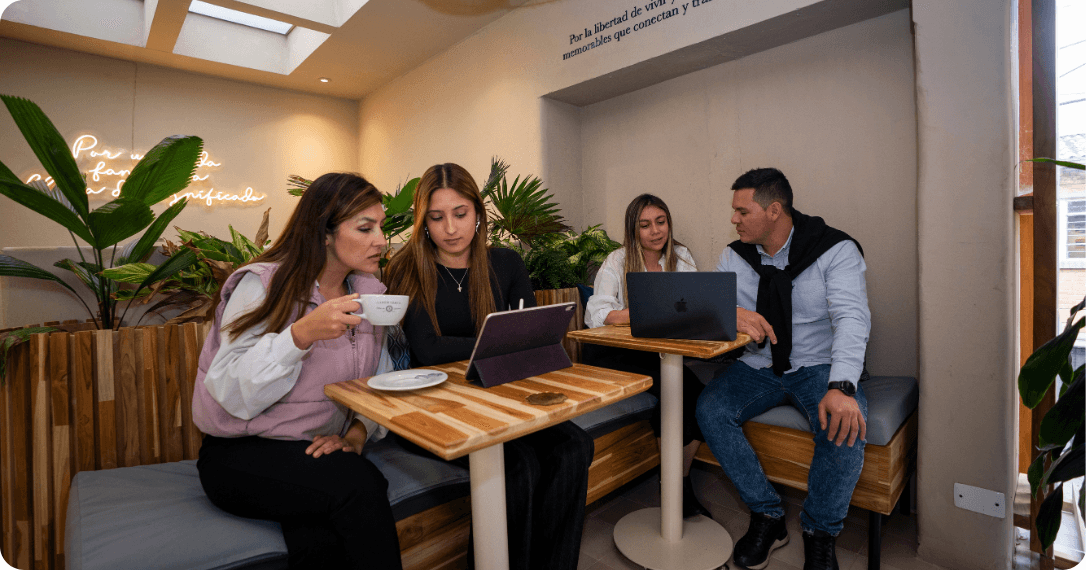
Many people don’t want to choose between home or office. They want intermediate options. Spaces that allow focus, collaboration, and belonging without rigidity.
This is where platforms like Pluria make sense from a wellbeing perspective. Not just as logistics, but as enablers of intentional connection.
When teams choose coworking spaces for key moments:
- Conversations become more intentional
- Collaboration feels lighter
- Presence becomes a choice, not an obligation
- Work recovers its social dimension
Wellbeing cannot be imposed. It can only be facilitated.
The concept of social wellbeing at work lives here too. In feeling that you belong, that you have room to maneuver, and that your work environment does not work against your health.
Conclusion: Wellbeing Is Not a Program, It’s a Signal
You don’t notice wellbeing when everything is fine. You notice it when it starts to disappear.
- In irritability without a clear cause.
- In apathy toward projects that once mattered.
- In teams that deliver but no longer feel engaged.
- In leaders who solve problems but feel increasingly worn down.
That’s why employee wellbeing is not a yearly initiative or a benefit to add. It’s a constant signal. A quiet thermometer that shows how an organization truly functions beyond results.
Here’s a thought we rarely explore: wellbeing doesn’t start when “things get better.” It starts when someone pauses to notice.
Before changing policies or spaces, we need to change how we look at everyday work. Because wellbeing is built through small, repeated, almost invisible decisions.

If you want to know whether wellbeing is truly part of your life or your team’s, start with these questions:
Five questions for reflection
- How do I feel most days when I start working, not during peaks but in daily routine?
- Can I say when something overwhelms me without fear?
- Does my energy recover, or only get consumed week after week?
- Does my work environment support focus or drain it?
- Do I have real moments of connection, or only task-based interactions?
And if wellbeing isn’t where it should be, change doesn’t need to be radical.
Five small actions to shift your mindset
- Normalize talking about how work feels, not just how it gets done
- Review whether flexibility is real or only theoretical
- Observe space: does it support or hinder daily wellbeing?
- Create conversations where productivity doesn’t need to be proven
- Allow yourself, as a leader or as a person, to not be okay all the time
Employee engagement and wellbeing are not built through perfection, but through attention.
That may be the real starting point for change. Not doing more, but looking differently.
Remote work
Keep up to date with our most recent articles, events and all that Pluria has to offer you.
By subscribing to the newsletter you agree with the privacy policy.

The future is hard to predict.
Unfortunately, there’s no crystal ball that can tell us exactly what will happen. Yet, there are structured methods that[...]
22 October, 2025

In today’s fast-paced business environment, projects move faster than ever before.
Customer expectations shift constantly, new competitors enter [...]
29 October, 2025
More often than not, the best ideas do not develop in a linear fashion.
As a matter of fact, they usually emerge from a single word, an unexpected conn[...]
07 November, 2025