Task Breakdown: How to Structure Project Work With Clarity and Control

16 January, 2026
Share this article
Table of Contents
I remember one of the first large projects a colleague had to manage as a Project Manager. The plan looked solid, deadlines were defined, and the team was motivated.
A few weeks in, everything started to fall apart. Tasks appeared that no one had planned for, deliverables were unclear, and discussions about ownership became constant.
The issue was not execution. It was structure.
That experience highlights the real value of a task breakdown. Not as a bureaucratic exercise, but as a way to think clearly about a project before execution begins. When work is not properly broken down, even strong teams struggle to stay aligned.
A well-defined task breakdown helps Project Managers turn complex initiatives into manageable, visible units of work. It brings clarity to scope, improves coordination, and makes progress predictable instead of reactive.
If you have ever asked yourself what a work breakdown structure really is, or how it differs from a simple project tasks list, this article will give you a clear framework.
We will walk through project planning steps, show how task breakdown supports better planning, and explain how modern task management software fits into this process.
What is a Task Breakdown?
Task breakdown is the process of dividing a project into smaller, manageable components until each piece of work is clearly defined, measurable, and assignable. The goal is not to describe how work will be done, but to identify what needs to be delivered.
In project management, task breakdown is most commonly represented through a work breakdown structure, often referred to as a WBS. A WBS organizes all project deliverables into a hierarchical structure that represents 100% of the project scope.
At its core, task breakdown answers one essential question for every Project Manager: What exactly must be delivered for this project to be considered complete?
A proper work breakdown structure does not focus on timelines or sequencing. Those elements come later through scheduling tools such as gantt chart planning. Instead, it provides the foundation upon which all other planning decisions are built.
A Brief History of the Work Breakdown Structure (WBS)
The concept of the work breakdown structure originated in large-scale engineering and defense projects in the mid-20th century. Organizations managing highly complex initiatives needed a way to ensure that no part of the work was overlooked.
As project management matured as a discipline, the WBS became a formal standard adopted across industries. Today, it is a core component of modern project planning steps and a key reference in frameworks such as PMBOK.
While its origins are technical, the principle of task breakdown has proven equally valuable in less rigid environments. Whether managing software development, organizational change, or cross-functional initiatives, the WBS remains one of the most effective tools for defining scope and controlling complexity.
Task Breakdown and the Project Planning Steps
Effective project planning steps always start with structure.
Before building timelines, assigning resources, or selecting tools, Project Managers need clarity on what the work actually is.
Task breakdown plays a critical role in this process:
- It defines the full scope before scheduling begins
- It prevents hidden or forgotten work
- It creates a shared understanding across stakeholders
- It serves as the basis for estimates, responsibilities, and risk management
Without task breakdown, even the best task management software or Gantt chart planning tools will amplify confusion instead of reducing it.
How to Create a Task Breakdown Using a Work Breakdown Structure
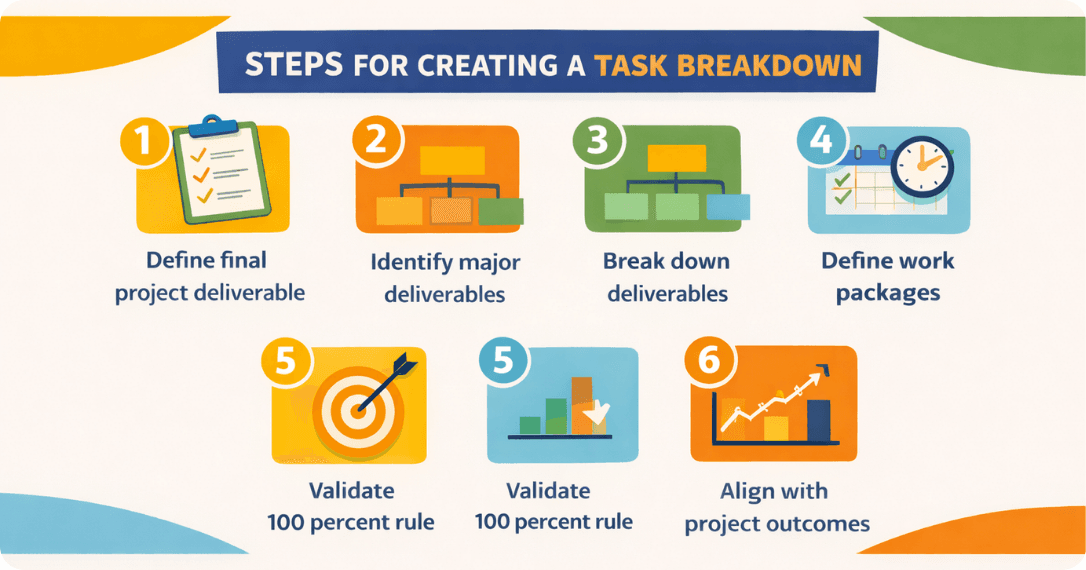
Creating a task breakdown is a practical process. These steps are designed for Project Managers who need operational clarity, not theoretical models.
1. Define the Final Project Deliverable
Start by clearly defining what the finished project looks like. This is not an activity, but a concrete outcome.
Example: Instead of “configure the system,” the deliverable is “system implemented, tested, and approved by stakeholders.”
2. Identify Major Deliverables
Break the project into large components or phases. These form the top levels of your work breakdown structure.
Example: Design, development, testing, training, deployment.
3. Decompose Deliverables Into Subcomponents
Each major deliverable is further broken down until the work becomes understandable and manageable.
Example: Testing may include functional testing, integration testing, and user acceptance testing.
4. Define Work Packages
Continue breaking down until each unit of work can be estimated, assigned, and tracked. These are your work packages.
Example: User acceptance testing may include test case definition, execution, and defect documentation.
5. Validate the 100% Rule
Ensure that the work breakdown structure represents 100% of the project scope. Nothing should be missing or duplicated.
6. Align With Project Outcomes
Every element of the task breakdown should clearly contribute to the project’s intended results. If a work package does not add value, it should be questioned.
Task Breakdown Example in Practice
A task breakdown example often reveals its value when projects seem simple at first glance.
Imagine a Project Manager responsible for coordinating monthly in-person alignment sessions for a distributed team.
Initially, the project is described as “organize monthly meetings” That vague definition quickly leads to confusion.
By creating a work breakdown structure, the project becomes clearer:
- Planning and objectives
- Location and logistics
- Communication and scheduling
- Session execution
- Follow-up and evaluation
Each area is then broken down further into specific work packages. What was once a vague initiative becomes a structured, manageable project.
This task breakdown example shows why structure matters even for non-technical projects.
Advantages of Using Task Breakdown in Project Management
Before teams talk about timelines, tools, or execution speed, they need structure. This is where task breakdown proves its value.
Breaking work down properly changes how Project Managers plan, communicate, and control projects from start to finish.
- Clearer Scope Definition: A well-built task breakdown makes the full scope of the project visible from day one. This reduces misunderstandings with stakeholders and protects the project from scope creep later on.
- More Accurate Estimates: When work is divided into smaller, concrete components, estimates become more reliable. Over time, this leads to more realistic budgets and timelines across projects.
- Better Responsibility Assignment: Task breakdown allows responsibilities to be assigned at the right level of detail. Each work package has a clear owner, which eliminates ambiguity and overlapping accountability.
- Stronger Progress Tracking and Control: With a structured breakdown, progress can be measured objectively. Project Managers can see exactly which deliverables are complete, in progress, or blocked.
- Reduced Risk of Missing Critical Work: The 100% rule forces teams to think through all required work. Tasks that are often forgotten, such as validation, documentation, or closure activities, become visible. This significantly reduces last-minute surprises during execution.
Taken together, these advantages show that task breakdown is not an administrative step. It is a strategic tool that gives Project Managers clarity, predictability, and control throughout the entire project lifecycle.
Task Management Software and Task Breakdown
Modern task management software does not replace task breakdown. It supports it.
A strong work breakdown structure should exist before tasks are entered into any system. Software simply helps visualize, assign, and track what has already been defined.
Good task management software allows Project Managers to:
- Translate a WBS into a structured project tasks list
- Assign owners and deadlines
- Track progress across teams
- Integrate scheduling tools like gantt chart planning
Examples of widely used tools include Asana, Jira, and Microsoft Project. Each supports task breakdown differently, but none can compensate for poor structure.
Task Breakdown Template vs Software
Many teams start with a task breakdown template before moving into software. This approach often leads to better results.
A task breakdown template allows teams to focus on thinking rather than formatting. Once the structure is validated, it can be transferred into task management software with confidence.
The most common mistake is using software to define the work instead of to manage it. A tool can organize tasks, but only task breakdown defines scope.
Task Breakdown, Gantt Chart Planning, and Execution
Once a task breakdown is complete, teams are ready to move from structure to scheduling. This is where gantt chart planning becomes relevant.
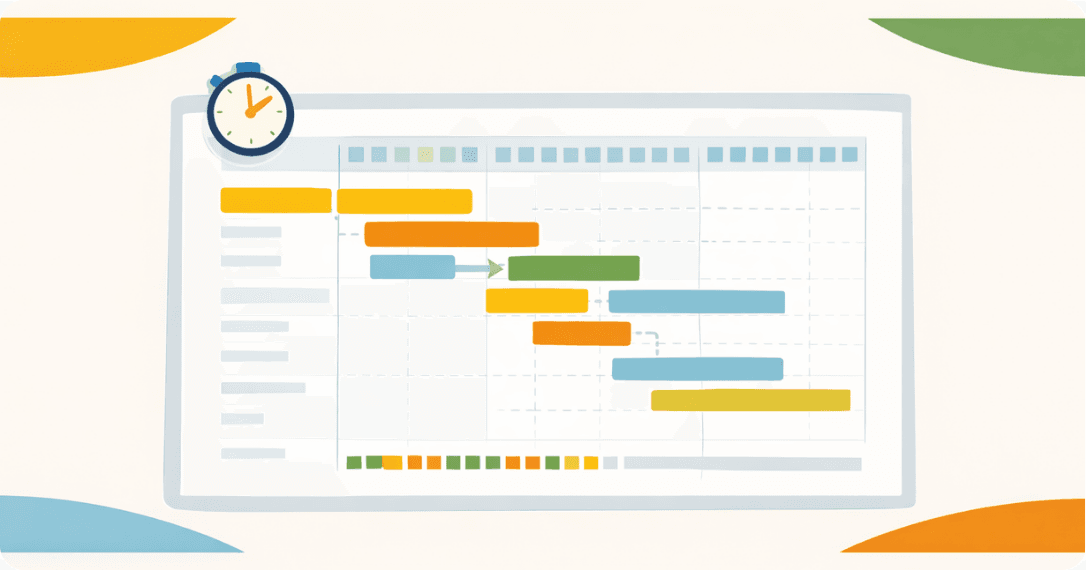
A Gantt chart is a visual timeline that shows project tasks along a horizontal time axis. Each task is represented by a bar, indicating start date, duration, and end date. Dependencies between tasks are often shown through connecting lines, making sequencing visible.
How Gantt Charts Work
Gantt charts rely on three key elements:
- Defined tasks
- Estimated durations
- Task dependencies
Without these inputs, a Gantt chart becomes guesswork. This is why task breakdown must come first. A work breakdown structure defines what needs to be scheduled before any dates are assigned.
How Task Breakdown Supports Gantt Chart Planning
Task breakdown provides the raw material for Gantt charts. Each work package becomes a schedulable task. Dependencies are easier to identify because the structure already shows how deliverables relate to one another.
When Project Managers skip task breakdown and jump straight into gantt chart planning, timelines often look polished but collapse during execution. Tasks are too large, dependencies are unclear, and progress becomes difficult to track.
From Planning to Execution
With a solid task breakdown in place, gantt chart planning becomes a realistic reflection of the project. Execution flows more smoothly because:
- Tasks are clearly defined
- Sequencing makes sense
- Progress can be measured accurately
In practice, task breakdown defines the work, Gantt charts organize it over time, and execution becomes manageable instead of chaotic.
Common Mistakes in Task Breakdown
Even experienced Project Managers make mistakes when creating a task breakdown. These issues often appear early but create serious problems later if not addressed.
- Breaking work into activities instead of deliverables: Activities describe actions, not outcomes. This makes scope unclear and weakens progress tracking.
- Creating work packages that are too large: Oversized tasks are hard to estimate and manage. They hide risk instead of reducing it.
- Overcomplicating the structure: Too many levels make the breakdown difficult to maintain. Simplicity improves usability and adoption.
- Skipping validation with the team: When the team is not involved, important work is often missed. Validation ensures shared understanding and completeness.
- Treating the task breakdown as static: Projects change, and the breakdown must change with them. A frozen WBS quickly becomes outdated.
Most task breakdown failures are not technical. They come from rushing the process or treating it as a formality. Avoiding these mistakes keeps the breakdown useful throughout execution.

Recommendations for Effective Task Breakdown
A good task breakdown does not happen by accident. It is the result of deliberate choices made during planning.
- Focus on deliverables, not actions: Deliverables define outcomes clearly. This keeps scope aligned and avoids unnecessary detail.
- Limit the level of detail: Stop breaking work down once it is manageable. Too much detail adds complexity without value.
- Involve the team early: Collaboration improves accuracy and buy-in. Teams help identify missing or unclear work.
- Validate the 100% rule: Review the structure carefully to ensure completeness. Missing work always creates problems later.
- Update the breakdown when scope changes: A task breakdown is a living reference. Keeping it current preserves its usefulness.
Following these recommendations helps ensure that task breakdown supports real project control. For Project Managers, a well-maintained breakdown becomes a reliable guide from planning through delivery.
Conclusion
Task breakdown is not just a planning technique. It is a way of thinking about work before execution begins. When projects are properly broken down, risks become visible, responsibilities are clear, and control becomes proactive instead of reactive.
For Project Managers, mastering the work breakdown structure means building a reliable foundation for every project. Tools like task management software, gantt chart planning, or a task breakdown template only work when that foundation is solid.
If you want to apply this today, take your next project and build the task breakdown before creating timelines or assigning resources. That single step often determines whether a project feels chaotic or controlled from day one.
Remote work
Keep up to date with our most recent articles, events and all that Pluria has to offer you.
By subscribing to the newsletter you agree with the privacy policy.

The future is hard to predict.
Unfortunately, there’s no crystal ball that can tell us exactly what will happen. Yet, there are structured methods that[...]
22 October, 2025

In today’s fast-paced business environment, projects move faster than ever before.
Customer expectations shift constantly, new competitors enter [...]
29 October, 2025

More often than not, the best ideas do not develop in a linear fashion.
As a matter of fact, they usually emerge from a single word, an unexpected conn[...]
07 November, 2025