The Invisible Pay Cut in Bucharest

30 March, 2026
Share this article
Table of Contents
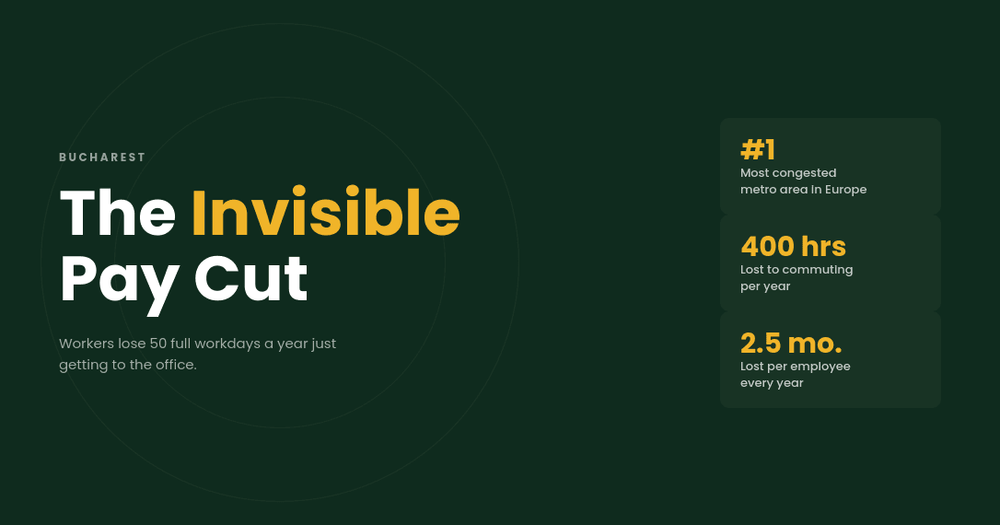
Bucharest holds a record nobody wanted. The most congested metropolitan area in Europe. For the people working here, that ranking has a price: up to 400 hours a year lost to commuting, or 50 full workdays, spent in traffic instead of at a desk, at home, or anywhere else they would rather be.
This isn't a story about long-distance commuters. Most people who work in Bucharest also live there. The problem is the city itself: too many cars, not enough alternatives, and roads that were never meant to carry this much. And lately, with fuel prices at levels that make every commute feel like a small financial decision, even driving has started to feel like a luxury.
Return-to-office mandates are back across Europe, and most of them come with a cost nobody talks about: commuting is not free. In the United States, a 2025 analysis by MyPerfectResume found that the average worker loses 223 hours a year just getting to and from the office. Researchers called it the invisible pay cut. In Bucharest, where commutes are longer and salaries lower, it has become a visible cut.
The Fuel Price Effect
The war in Iran sent fuel prices across Europe to levels that changed daily decisions. In Bucharest, the math became simple fast: driving to work was no longer just slow. It became expensive.
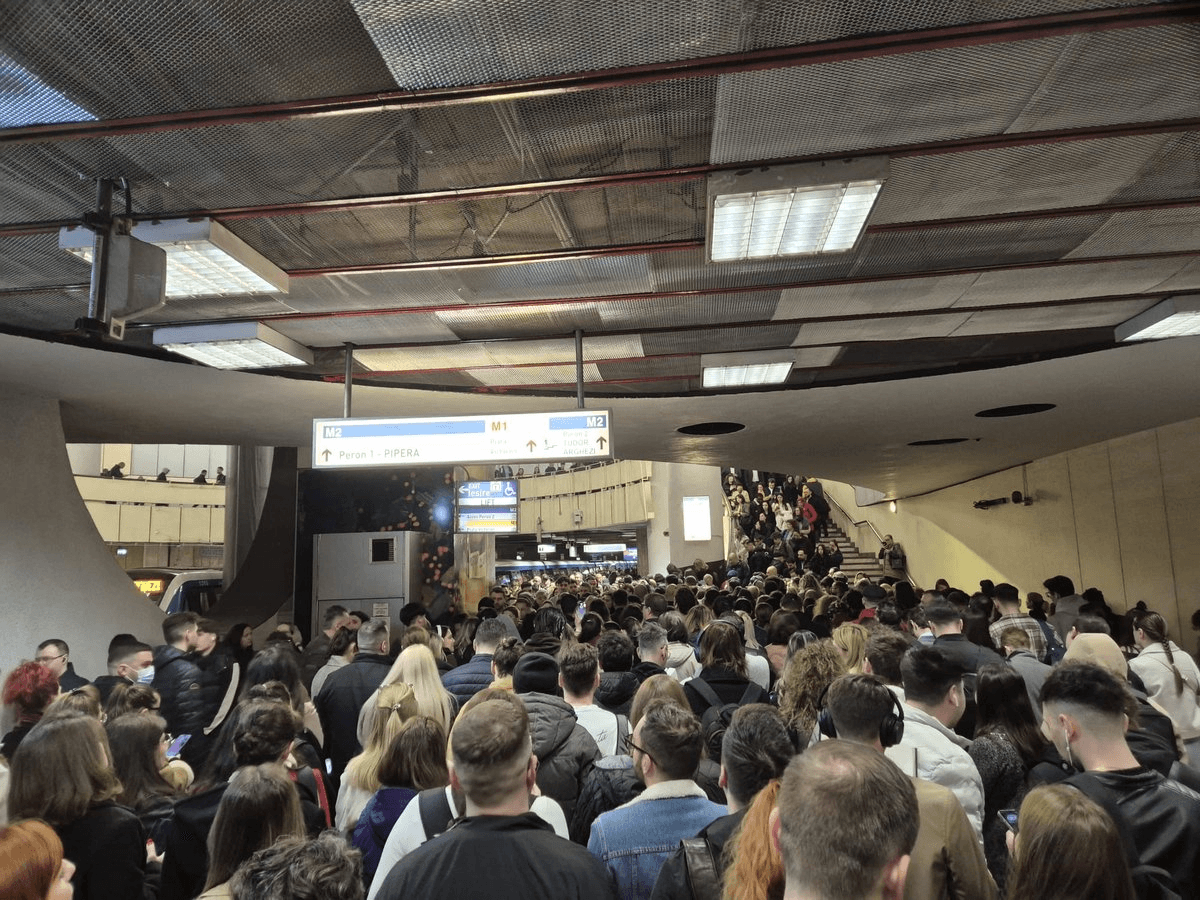
So people switched to the metro. Hundreds of thousands of them, all at once, all making the same rational choice.
The problem is that Bucharest's metro was not built for this. Earlier this month, commuters at Victoriei station waited through five consecutive trains before they could physically board one. The escape route got congested too.
This is what makes Bucharest's commute problem different from a simple traffic story. It is not about choosing the wrong lane or the wrong hour. Whether you drive or take the metro, the city charges you the same toll: time. And right now, that toll is getting higher.
50 Days. Every Year.
According to TomTom's 2025 traffic data, a 10-kilometer trip during evening rush hour in Bucharest takes 45 minutes. The average commute distance in the city is 10.7 kilometers, meaning a typical one-way peak-hour commute is roughly 48 minutes.
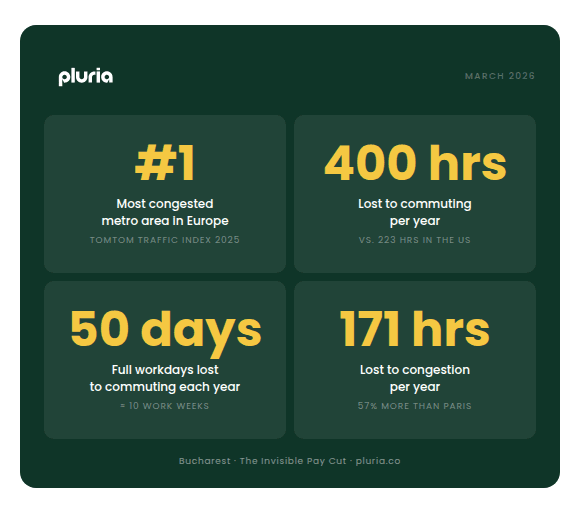
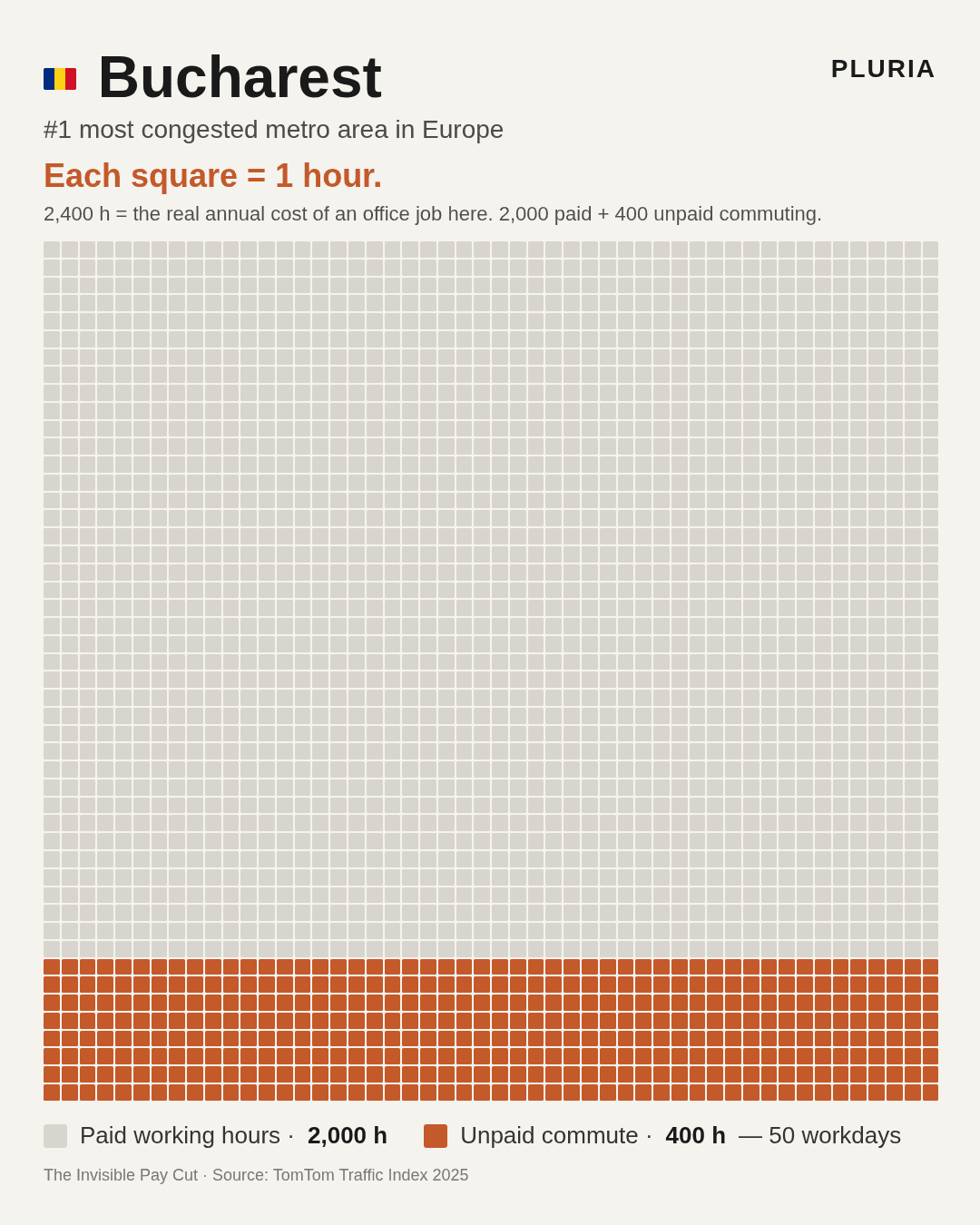
Across 250 workdays, a 48-minute commute each way adds up to up to 400 hours per year spent in transit. That is the equivalent of up to 50 full workdays, or nearly 10 working weeks of unpaid travel time.
For comparison, the average American worker loses 223 hours per year to commuting, roughly 28 workdays.
For a worker who commutes every day, that adds up to 2,400 hours a year given to their job. Only 2,000 of those hours are paid. The other 400 are the invisible cost of getting across the city and back. Requiring a Bucharest employee to commute to a central office every day is equivalent to asking them to work from January through mid-March for free, just to sit in traffic.
Bucharest vs. Europe
The comparison with other European capitals tells the same story in a different register.
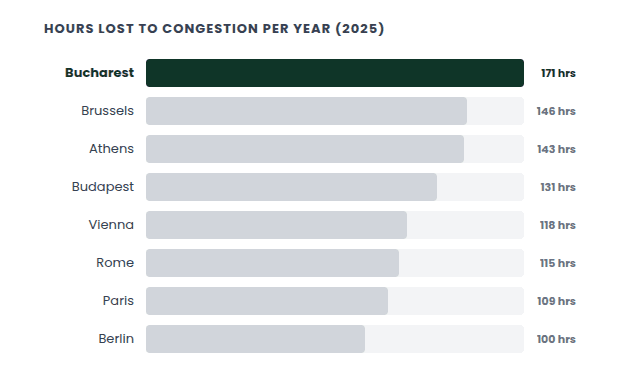
Bucharest workers lose 57% more time to congestion than their counterparts in Paris, and 71% more than workers in Berlin. The average speed across the city is just 18.5 km/h. A determined cyclist can beat that.
And the trend is moving in the wrong direction. TomTom data shows Bucharest residents lost 7 hours and 40 minutes more to congestion in 2025 than the year before. This is not a temporary problem.
Why It Keeps Getting Worse
Bucharest's traffic crisis is structural, not cyclical.
The city and its surrounding Ilfov county added 560,000 registered cars between 2011 and 2022, pushing the total toward 1.8 million vehicles. Satellite towns like Voluntari, Bragadiru, and Popesti-Leordeni are growing at some of the fastest rates in Romania, adding tens of thousands of new residents who funnel daily into a road network that was not designed for them.
The metro system is clean and functional, but it covers only 44% of the urban area's population. Metro Line 6, which would connect the airport to northern business districts, remains under construction and will not open until at least 2028.
More people. More cars. Same roads. And every year, the commute gets a little longer.
A Talent Problem
Bucharest has quietly become one of Europe's most important tech hubs. Adobe's largest EMEA R&D center is here. Amazon, Microsoft, Google, Accenture, and hundreds of local startups have built real operations in the city, drawn by a deep pool of software engineers and competitive costs.
Those same engineers are losing 50 workdays a year to traffic.
Research from Harvard, Brown, and UCLA found that workers would give up roughly 25% of their total compensation for remote or hybrid flexibility. In Bucharest, many are already giving away 20% of their working time. Not by choice. By geography.
People notice. They get tired, they get frustrated, and eventually they leave for companies that do not ask this of them. The return-to-office mandate in a city like Bucharest is not a culture decision. It is a transfer of costs from the company's balance sheet to the employee's time, energy, and money.
The Real Decision
The central office model imposes an unsustainable commute burden. But fully remote work comes with its own costs, particularly in Romania, where in-person relationships and team cohesion still matter deeply.
| Central Office | Full Remote | Nearby Workspaces |
| 50 days/year lost. Burnout. Attrition risk. | Isolation. Weak collaboration. Culture erosion. | 15-min commute. In-person culture. Collaboration preserved. |
The real decision is not office versus remote. It is commute distance.
Instead of concentrating everyone in a single headquarters, companies can provide access to professional workspaces close to where employees actually live. Teams meet in person, but without the 90-minute commute. The travel time drops to 15 minutes. Collaboration remains. Culture remains. The commute tax disappears.
The Question for HR Leaders
Every five-day RTO week in Bucharest costs each employee one full day of unpaid commuting. Over a year, that is nearly two and a half months lost to travel.
Companies that take this seriously are starting to do things differently:
- Give employees access to professional workspaces near where they actually live, not near headquarters
- Make in-person collaboration possible without requiring anyone to cross the city to do it
- Stop building policies around a transit system that is already at its limit
Not flexibility as a perk. Flexibility as infrastructure.
About Pluria
Pluria gives teams access to ready-to-use hybrid work infrastructure across Romania, Spain and Latin America. Through a single platform, employees can work from coworking spaces and work cafes, meet in professional meeting rooms, and coordinate in real spaces when collaboration matters. Companies keep visibility and manage their hybrid model without rigid contracts or long-term leases.
For distributed teams, it means time well spent working together, wherever they are.
Leadership
Keep up to date with our most recent articles, events and all that Pluria has to offer you.
By subscribing to the newsletter you agree with the privacy policy.

Is the corporate world “better” than the entrepreneurial one? At times, one party goes after the other with loud statements that it’s much better on their side. And I have to admit, it happens very often on[...]
04 December, 2023

I have seen recently many hardcore fans of returning to office (one way or another most have direct skin in the game for this to happen, but that’s a different topic) who loudly proclaim that a physical off[...]
04 December, 2023

I was working from a dressing room (literally) for several months already, having online meetings and talking to clients among clothes hangers, shirts and shoes, with my son interrupting me for drawing pape[...]
04 December, 2023