What Is An OKR? Meaning, Examples and Benefits for Businesses

10 December, 2025
Share this article
Table of Contents
Early in my career I realized that writing down objectives is an essential step for achieving any meaningful milestone. Still, I often struggled to define them in a concrete, measurable, and truly achievable way.
With time I learned I was not alone.
Many teams create long lists of goals hoping that structure will bring clarity. But months pass, daily tasks take over, and those goals end up forgotten in a document no one opens again.
I went through that cycle more than once. After finishing a particularly chaotic project, I realized my goals were clear, but the path for achieving them was not. That was the moment when I heard about OKRs, also known as Objectives and Key Results.
Unlike other frameworks, the OKR methodology does not only tell you where you want to go. It also tells you how to measure progress in a simple and reliable way. An Objective clarifies what you want to achieve, and the Key Results show how you will track measurable outcomes along the way.
The best part is that OKRs are not rigid or complicated. They offer a simple structure that helps teams focus their energy on what truly matters instead of chasing goals that do not have a concrete plan behind them.
If you have struggled to identify what actions truly drive the results you want, this guide can help. In this article, we will explore the OKR meaning in business, how the framework works, and how you can use it to bring clarity to your work.
What Are OKRs?
Definition of OKR
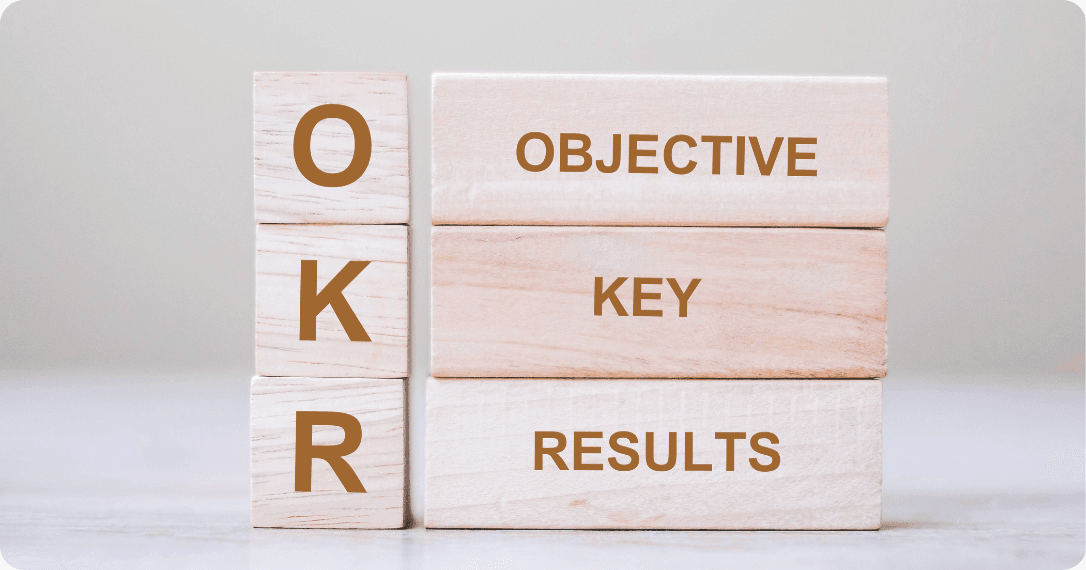
OKR stands for Objectives and Key Results, a goal setting framework that combines a qualitative objective with a set of measurable key results.
In simple terms, the Objective describes what you want to achieve, while the Key Results explain how you will measure progress in clear, quantifiable terms.
Their purpose is to help teams prioritize effectively, align efforts, and stay focused on high impact activities.
Unlike traditional planning methods, OKRs do not try to list every possible metric. They identify the essential elements that define success and make progress visible.
A well written OKR gives you a clear destination and a realistic path for getting there. It creates a bridge between strategy and everyday work.
To understand why this structure is so useful across industries, it helps to look at where the OKR methodology comes from.
Origin and Evolution of OKRs
The idea behind OKRs began in the mid-twentieth century when management expert Peter Drucker introduced the concept of Management by Objectives. His goal was to align organizational priorities with individual contributions.
Years later, Andrew Grove, then CEO of Intel, refined Drucker’s idea and transformed it into a more practical model. Grove gave the framework its name, Objectives and Key Results, and made it a core discipline inside Intel.
That being said, it was John Doerr who brought OKRs to global attention. After learning of the method at Intel, he introduced OKRs at Google during its early years. The company adopted the framework to maintain focus during rapid growth, and OKRs became a fundamental part of their operating culture.
Over the following decades, the OKR methodology expanded far beyond the tech industry. Today it is used by startups, HR teams, nonprofit organizations, and global companies seeking clarity, alignment, and measurable outcomes.
OKRs Today
OKRs have evolved into a flexible framework that works for small teams, large enterprises, and even individual contributors. They are valued for their ability to make priorities visible, align people toward shared goals, and create honest conversations about real progress.
OKRs are especially helpful in fast-changing environments where goals need regular adjustments. They promote transparency, autonomy, and a practical way to connect daily work with long term vision.
The OKR Methodology
The OKR methodology does not consist of simply writing random goals. Its strength lies in its simplicity: one clear Objective and a small number of Key Results that reveal whether your effort is working.
Below are the practical steps for creating OKRs that truly work:
1. Define a clear and specific Objective
Your Objective should answer one question: What do we want to achieve in this cycle?
It should be qualitative, inspiring, and easy to remember. Avoid vague goals that sound bureaucratic or overly generic.
A strong Objective gives emotional and strategic direction. It also helps you identify what not to do.
Example scenario: Imagine a marketing team creating an OKR for improving lead generation.A bad objective would be: “Improve our marketing quality.” A strong, focused objective would be: “Increase the number of qualified leads to help the sales team grow faster.”
2. Identify two to four measurable Key Results
Key Results turn intention into measurable outcomes. Each KR answers the question: How will we know if we are making progress?
They should include specific metrics like percentages, quantities, or time based improvements. Key Results do not describe tasks, they describe measurable changes in performance.
In most teams, two to four KRs are enough to measure success without losing focus.
Example Key Results:
- KR1: Increase the number of qualified leads by 30 percent.
- KR2: Reduce cost per lead by 20 percent without compromising quality.
- KR3: Increase monthly organic traffic by 25 percent.
3. Align the OKR with organizational priorities
An OKR gains strength when it supports broader company goals. This does not mean copying high level objectives. It means translating them into what your team can directly influence.
Alignment prevents duplicated effort and encourages useful conversations across teams.
Example scenario: If the company wants to increase quarterly sales, the marketing team checks that their definition of a “qualified lead” matches what the sales team needs to close deals.
4. Set a realistic time cycle
Most teams use quarterly OKR cycles. They are long enough to see real progress and short enough to remain adaptable.
The important part is choosing a defined time frame so everyone works toward the same horizon.
Example scenario: The marketing team agrees that one quarter is enough time to launch campaigns, optimize performance, and track results.
5. Review progress frequently
An OKR loses value if it is only reviewed at the end of the cycle. Weekly or biweekly check-ins help teams stay aware of challenges and adjust early.
These meetings should be brief and focused on measurable outcomes.
Example scenario: The marketing team meets every Monday for 15 minutes. If KR2 is falling behind, they adjust ads or allocate resources differently.
6. Evaluate and adjust at the end of the cycle
At the end of the period, review each Key Result honestly. This reflection is part of the OKR methodology. It prevents teams from repeating the same mistakes and reinforces what worked well.
Example scenario: The marketing team realizes that organic content took longer to scale than expected. They adjust their next OKR to include more realistic growth targets.
Creating strong OKRs does not require advanced experience or complex tools. It requires intention, clarity, and a commitment to measure real progress.

OKR Examples for Different Teams
Below are simple OKR examples across different business areas. Each includes one Objective and three measurable Key Results:
Human Resources and Talent OKR Example
Objective: Improve talent retention and strengthen the employee experience.
- KR1: Increase retention rate by 15 percent this quarter.
- KR2: Implement a new onboarding process and achieve at least 85 percent satisfaction.
- KR3: Reduce average hiring time by 20 percent without compromising candidate quality.
Sales OKR Example
Objective: Increase revenue by focusing on high potential strategic accounts.
- KR1: Grow revenue from the top 20 percent of accounts by 25 percent.
- KR2: Reduce sales cycle length for qualified opportunities by 30 percent.
- KR3: Increase proposal to close conversion rate by 20 percent.
Product and Development OKR Example
Objective: Improve user experience and accelerate the delivery of new features.
- KR1: Reduce average feature deployment time by 40 percent.
- KR2: Increase user satisfaction score from 7.5 to 8.5.
- KR3: Resolve 80 percent of critical bugs within 48 hours.
OKR vs KPI: What’s the Difference?
When I talk with teams about planning and measurement, one of the first questions that comes up is the difference between OKRs and KPIs.
At first glance they seem similar, but they serve different purposes.
A KPI is a performance indicator that tracks the health of an existing process. It measures things like conversion rates, response times, or operational efficiency. KPIs tell you what is happening right now and whether performance is within a healthy range.
OKRs, on the other hand, are built for movement. An OKR combines a qualitative Objective with measurable Key Results to push a team toward meaningful change.
A KPI tells you where you are, where an OKR tells you where you want to go.
If a customer support team wants to significantly improve response times to create a better user experience, that change is better expressed as an OKR than as a KPI.
The truth is they complement each other. KPIs describe the present. OKRs design the future.
Benefits of Implementing OKRs
Strong OKRs reduce noise, align energy, and make collaboration feel lighter and more meaningful. Here are some of the most important benefits of OKR:
- Focus on what truly matters: Instead of juggling fifteen priorities, the team identifies the three that actually change outcomes. For example, a marketing team may stop spending hours on reports and focus instead on the two initiatives that generate most of their demand.
- Better alignment across teams: OKRs connect day to day work with what the organization needs to move forward. This builds clearer communication between leaders and contributors.
- Greater transparency and accountability: OKRs make goals visible. Everyone knows what is being measured and why. This creates a culture where progress is discussed openly and achievements are celebrated.
- Generates innovation and strategic thinking: When a team pursues an ambitious objective supported by measurable outcomes, they naturally experiment, challenge outdated processes, and explore new ideas.

Tips for Implementing OKRs Effectively
Adopting OKRs is simple, but it requires intention. These tips help teams use OKRs consistently instead of treating them like a one time exercise.
- Start with a small number of objectives. This keeps the team focused and prevents dilution.
- Choose Key Results that can be measured without interpretation. Clear metrics create clarity.
- Make OKRs visible to the entire team. Transparency creates coherence and alignment.
- Review progress weekly. Ten minutes is enough to course correct.
- Let the team participate in the creation process. Collaboration increases commitment.
- Use OKRs to prioritize weekly work. They should guide decisions, not sit in a document.
- Accept that not every OKR will be fully achieved. Learning is part of the methodology.
Implementing OKRs is not about filling templates or chasing numbers. It is about giving your team direction and building a shared language that connects daily work with long term purpose.
When objectives are clear and key results are measurable, everything changes. Priorities become visible, meetings become shorter, and decisions feel easier. Above all, people feel their work has meaning.
The beauty of the OKR methodology is that you do not need to be a large company to benefit from it. Small teams, individual projects, and even personal goals can use OKRs to gain clarity.
Before you finish reading this guide, think about your next quarter. Choose one objective that truly matters to you and write down three measurable outcomes.
Start there. Sometimes a little clarity is enough to transform the way you work.
Remote work
Keep up to date with our most recent articles, events and all that Pluria has to offer you.
By subscribing to the newsletter you agree with the privacy policy.

The future is hard to predict.
Unfortunately, there’s no crystal ball that can tell us exactly what will happen. Yet, there are structured methods that[...]
22 October, 2025

In today’s fast-paced business environment, projects move faster than ever before.
Customer expectations shift constantly, new competitors enter [...]
29 October, 2025

More often than not, the best ideas do not develop in a linear fashion.
As a matter of fact, they usually emerge from a single word, an unexpected conn[...]
07 November, 2025